

 spasia_lm@uzabase.com

Data Insights
Vietnam’s Pivot to Quality FDI: Where the Private Market Opportunities are Shifting

This article highlights key findings from Speeda’s “Vietnam’s Manufacturing Ascent: The Pivot to Quality FDI” report, which examines how Vietnam’s foreign investment model is changing and how key provinces are positioning for the next wave of high-value manufacturing.
Vietnam’s economy is growing at its fastest pace in over a decade. Real GDP grew 9.0% in the first nine months of 2026, the strongest nine-month rate since 2011, and the government is targeting at least 10% annual growth through 2030. For investors and advisory teams, however, the more important shift lies in the type of foreign capital Vietnam now seeks, not the volume. With Resolution No. 10-NQ/TW, Vietnam is formally moving from FDI quantity to FDI quality. This transition highlights a gap that matters for investment and advisory professionals: domestic value added in Vietnam’s gross exports has fallen from around 80% in 1995 to about 52% in 2024.
Manufacturing is the Engine, and FDI Runs it
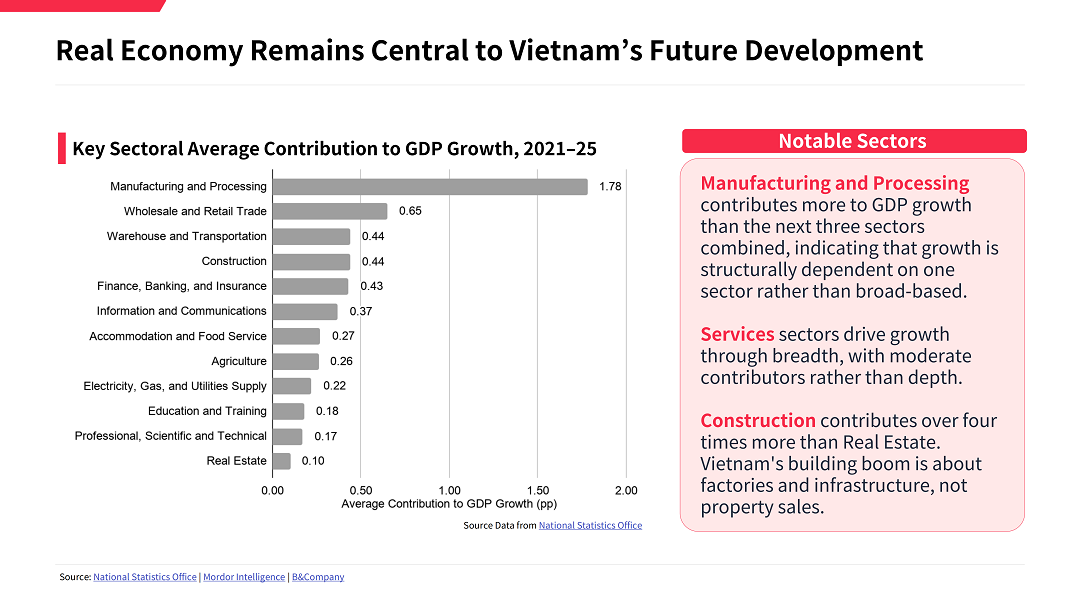
Vietnam’s growth is concentrated rather than broad-based. Manufacturing and processing contributed an average of 1.78 percentage points to GDP growth over 2021–25, more than the next three sectors combined. The government wants the sector to reach 28% of GDP by 2030.
Foreign companies dominate that engine. FDI firms accounted for 77.3% of Vietnam’s exports in 2025 and 62% of manufacturing revenue in 2024, despite being a relatively small share of firms. In practice, the direction of FDI policy determines whether Vietnam’s growth model moves up the value chain.
Resolution 10: From How Much FDI to What Kind
After nearly 40 years of integration, Vietnam’s FDI model still leans on tax incentives, low labor costs and resource advantages. Localization and domestic linkages have remained limited.
Resolution 10, issued on 8 June 2026, resets the priorities for 2026–30. It targets:
- USD 150–200 billion in realised FDI, against USD 118.3 billion in 2021–25
- 75% of investment from developed economies
- 45–50% localisation in key industries
- 10,000 domestic firms integrated into FDI value chains
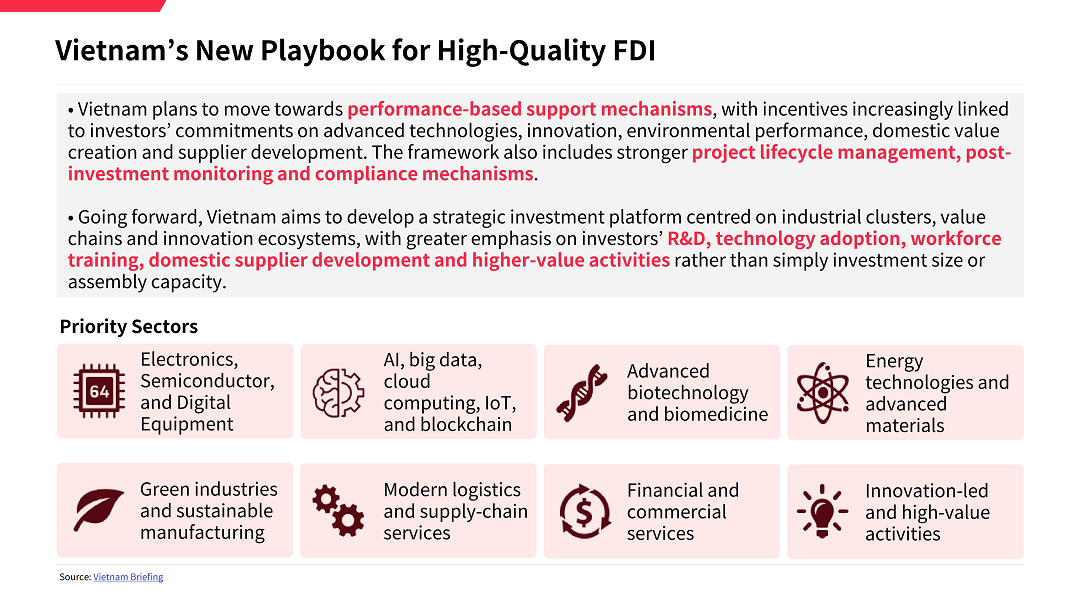
The incentive model is changing too. Support will increasingly be performance-based. Incentives will be tied to investors’ commitments on technology, R&D, workforce training and domestic supplier development, backed by post-investment monitoring and compliance checks. Priority sectors include electronics and semiconductors, AI and digital infrastructure, biotechnology, advanced materials and green manufacturing.
Recent projects show the shift is already happening. Samsung Electro-Mechanics announced a USD 1.2 billion FC-BGA substrate factory in April 2026, building on its earlier investment. Makino’s new precision engineering plant in Hung Yen has already reached over 80% localization and is targeting 90–95%.
The implication for investors: the next wave of FDI will reward investors that can show local sourcing and supplier development. That puts the spotlight on the domestic companies able to supply them.
The Domestic Value Capture Gap is the Opportunity
Higher-quality FDI does not automatically mean more value stays in Vietnam. Export growth remains heavily FDI-driven, and the domestic supplier base is still relatively weak. The innovation capability of local firms also shapes where multinationals choose to invest.
This gap is where the private market opportunity sits. As multinationals expand in semiconductors, electronics and precision engineering, they create demand for satellite companies and tier-2 and tier-3 suppliers. These include component makers, mould and tooling specialists, automation providers and technical service firms. The report notes that resilient, reliable and innovative SMEs are increasingly becoming a strategic asset in multinational investment strategies.
The implication for investors: the most actionable targets are likely to be the local private suppliers that multinationals need to meet localization commitments, rather than the multinationals themselves. Many of these suppliers are under-researched and difficult to find through public market sources.
Five Provinces, Five Different Plays
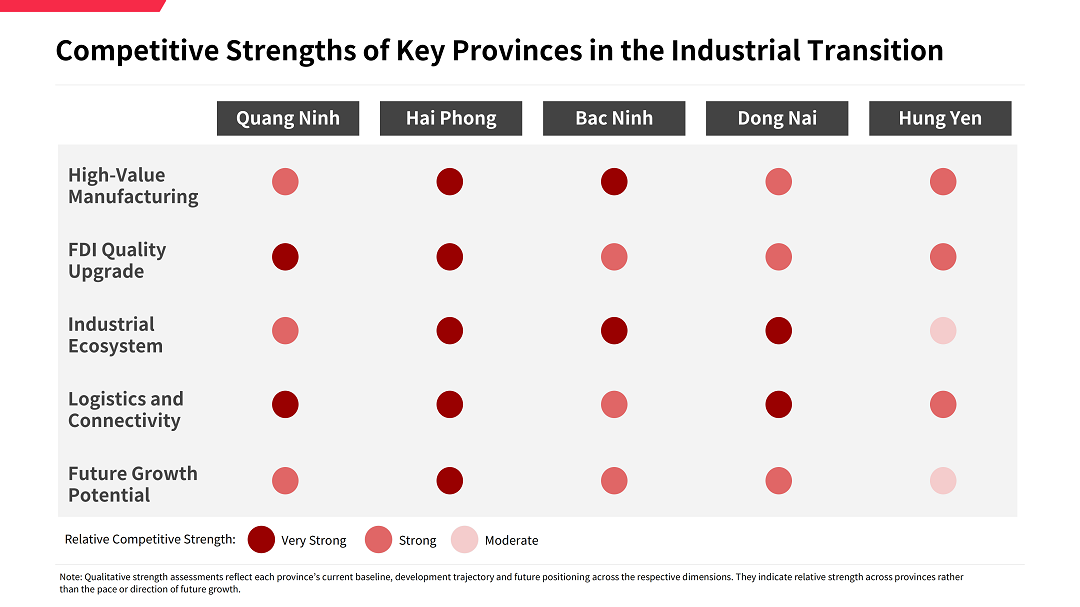
The report profiles five provinces positioning differently for the upgrade. (Note: 2025 figures for several provinces reflect the July 2025 provincial mergers and may not be directly comparable with earlier years.)
Hai Phong is the North’s port and high-tech manufacturing gateway. Its port system handles 40% of Vietnam’s container throughput. The city is prioritising semiconductors, robotics and optical equipment. LG Innotek’s USD 1.0 billion semiconductor substrate facility, its first outside South Korea, anchors that push.
Bac Ninh is Vietnam’s foremost electronics centre. FDI accounted for over 80% of the province’s industrial production value in 2025. It is now targeting chip design, packaging and testing, with plans to train 30,000 semiconductor workers by 2030.
Dong Nai is restructuring away from labour-intensive manufacturing and actively screening out low-tech and polluting FDI. Long Thanh International Airport and a planned 7,500-hectare free-trade area anchor its bid for high-tech manufacturing, R&D centres and regional headquarters.
Hung Yen is emerging as a platform for next-generation FDI. It plans 30 industrial parks by 2030 and recent projects span EVs, energy storage and AI-linked connectivity components. Chery’s first Vietnam plant is among them.
Quang Ninh is Vietnam’s only province with both land and sea borders with China. Investment intensity rose from roughly USD 1 million per hectare in 2016–20 to more than USD 13 million in 2021–25, a sign of more resource-efficient, higher-value FDI.
What This Means for PE/VC, M&A Advisory and TP Teams
For PE and VC investors, the localisation push creates a pipeline of growth-stage local suppliers in electronics, precision engineering, automation and components. Provincial clusters around multinational anchors are a practical starting point for sourcing.
For M&A advisors, multinationals under pressure to localise will look for acquisitions, joint ventures and supplier partnerships with capable domestic firms. Advisors who can map those suppliers early will be better positioned to originate mandates.
For transfer pricing professionals, performance-based incentives, localisation targets and new multinational supply chains raise the stakes on intercompany pricing and supply-chain structuring. Robust benchmarking against comparable local companies becomes more important as related-party flows through Vietnam grow in volume and complexity.
From FDI Headlines to Private Company Research
The policy direction is clear. The harder question is which local companies will capture the value. For deal and advisory teams, that means identifying suppliers by province, activity and scale, assessing their financials, and benchmarking them against peers. Most of these companies are privately held.
Speeda provides data on 12M+ private companies, with deep Southeast Asia coverage. Teams can shortlist potential targets using advanced search filters and 580+ proprietary Asia-focused industry classifications, alongside global and local SIC codes. Teams can build like-for-like peer sets for benchmarking and comparable company analysis, and draw on 3M+ M&A deals to identify relevant transaction comps for valuation and deal analysis.
To start screening Vietnam’s private manufacturing suppliers and building peer comps, request full access to Speeda below.
- Recommended Content