


 spasia_lm@uzabase.com
About Us
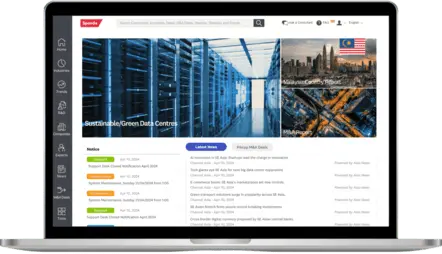
Speeda is a busines intelligence platform with essential information that truly focuses on Asia. We offer extensive private company data and key insights into the Southeast Asia market, providing comprehensive data on companies and industry information written by in-house local consultants you need for your initial research work.
Designed for professionals to streamline their research activities, company profiling, competitor benchmarking, deal sourcing, and industry analysis to enhance efficiency in business decision-making. The all-in-one platform delivers valuable insights into business valuation and Industry Reports and can save you time and cost for data analysis to make your decisions more efficiently.
Trusted by esteemed corporations








































 ?>
?> What Speeda brings to your business
Engage with the database at each stage of your research
Designed to elevate your research from identification to final output, Speeda streamlines every phase of your journey. Experience unparalleled efficiency through our vast data resources, deep analytics, and flexible output options, all tailored to meet your specific research needs.
Identify
Use the search bar to find companies, industries M&A deals and other data.


Search
Browse company profiles and financial results, industry reports and market data via a simple interface
Analyse
Customise data by search criteria, display data, and chart designs for your analysis


Create
Select company data and industry reports for download in PPT, DOC XLSX, or PDF format with a single click

Essential Company Information Truly Focusing on Asia
Gain unlimited access to our company database, which encompasses over 12 million public and private companies worldwide, including their financials. Speeda offers the widest coverage of private company data across the ASEAN-6 countries, Japan, China, and Korea. It is used by professionals for daily data gathering in business valuation research, target screening, deal sourcing, benchamrking, industry analysis, and more.
12M
Public and Private Company Data

Japan
627k

Singapore
632k

Malaysia
728k

Thailand
600k

Vietnam
1.1M

Korea
71k

China
2.2M
Time and cost efficiency in data gathering for your research projects
Increase your efficiency by obtaining local insights in minutes. Speeda stores more than 3,000 reports, including industry reports that provide a comprehensive understanding of market trends, highlighting businesses in Southeast Asia. These reports offer valuable insights to professionals in consulting, market analysis, or strategic corporate planning, elevating the efficiency and precision of market research and enabling them to bring impactful results to their businesses.
Market Insights from local Consultants
Read insightful articles delivered exclusively through Speeda. Written by in-house consultants, the reports zoom in on leading Southeast Asian countries on hot topics. Understand the impact of global trends on ASEAN regions and the growth opportunities they provide.

-
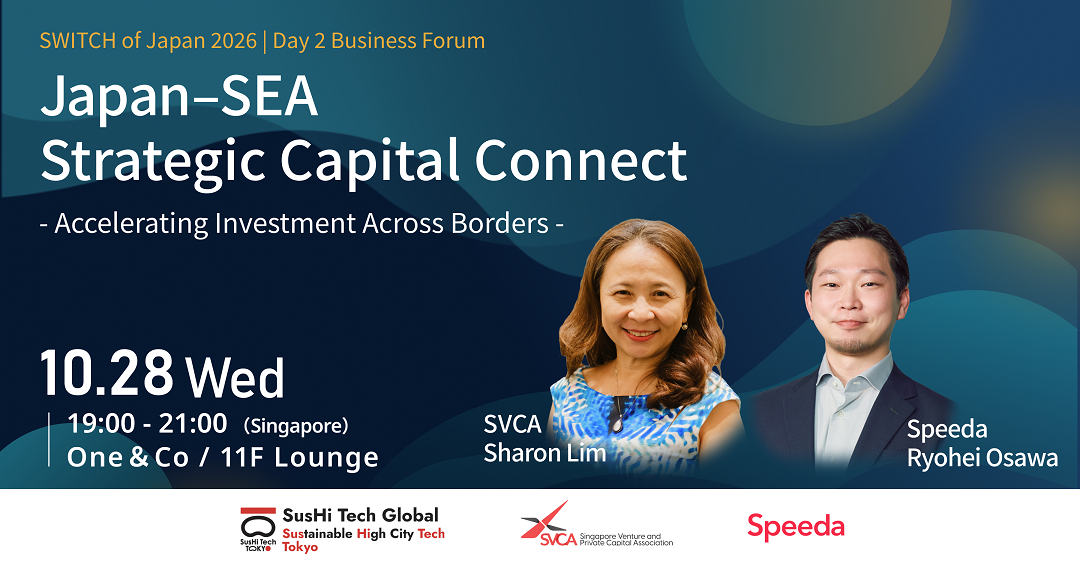
| IntroductionJapanese corporations are becoming increasingly active investors in Southeast Asia. For Singapore- and SEA-based PE/VC firms, they can be partners who bring more than capital, including industry expertise and access to the Japanese market. Yet the two communities still rarely have the chance to meet face to face.To bridge this gap, Speeda, together with SVCA (the Singapore Venture and Private Capital Association) and SusHi Tech Global, is hosting a networking event connecting local PE and VC investors with Japanese companies.The opening panel discussion will explore key trends in Asia’s investment landscape, how overseas investors view the Japanese market, and sectors currently attracting attention—from both Japanese and Singaporean perspectives.This will be followed by elevator pitches from Japanese startups participating in SWITCH through the Tokyo Metropolitan Government’s SusHi Tech Global program. VCs looking for investment opportunities and corporations seeking collaboration partners are also invited to connect with these startups.Companies Scheduled to Present Fermelanta, Inc.: Uses synthetic biology to produce rare, valuable natural compounds through microbial fermentation. OptQC Corp.: Develops commercial optical quantum computers that offer fast, energy-efficient information processing. WHILL, Inc.: Develops, manufactures and sells short-distance mobility products, and provides mobility services that use them.Whether you are based in Singapore or visiting during SWITCH, join us to meet local investors and exchange insights.Attendance is free, but seats are limited. We encourage you to reserve yours early.| Seminar OverviewDate Wednesday, 28 Oct 2026Time 7:00 - 9:00 pm / Singapore Time (GMT+8)Location One & Co Lounge 11F 20 Anson Road Singapore 079912 (Nearest MRT station: Tanjong Pagar)Registration deadline Monday, 26 OctoberLanguage English | Agenda6:30pm Registration opens7:00–7:25pm Panel discussion Sharon Lim (SVCA) × Ryohei Osawa (Speeda, Uzabase) Moderator: Bernard Loh (Sealed Network, Uzabase)7:25–7:40pm SusHi Tech Global Project introduction + Startups Pitch7:40–9:00pm Networking reception | SpeakersSharon Lim Chief Executive Officer, Singapore Venture and Private Capital Association (SVCA)Sharon leads SVCA’s work to develop Singapore’s private-market investment ecosystem, engaging regulators, investors and industry stakeholders. She has over 20 years of experience across private equity, venture capital, infrastructure, real estate and private wealth.Previously a journalist with S&P Global Platts, Dow Jones and PEI, Sharon later led PEI Conferences’ Asia business and founded Interest Alignment Management, a private-markets advisory. She holds a Master’s degree in Gerontology from SUSS and a degree from the National University of Singapore. SusHi Tech GlobalSusHi Tech Global is a public-private initiative that supports growth-stage startups pursuing global expansion. It has selected 114 startups whose technologies help solve urban challenges and create new value, with the goal of building sustainable cities and societies. Ryohei OsawaExecutive Officer, Global Business — Asia, UzabaseRyohei began his career in the Power Division of Marubeni Corporation, where he was responsible for investment projects. After joining Uzabase, he worked in sales and marketing for the Speeda business before becoming Chief Customer Officer for INITIAL, Uzabase.From January 2024, he led community building and business development. In July 2024, he was appointed Executive Officer responsible for financial institutions and consulting firms within the Speeda business. Since 1 April 2026, he has been responsible for post-merger integration of overseas acquisitions and the growth of the company’s international business. Bernard Loh (Moderator)Co-Founder/Head of BD & Partnerships, Sealed Network, a company of UzabaseBernard joined Citi Private Bank in 2020 as a Management Associate after completing its Summer Analyst Programme in 2019. In 2022, he co-founded Sealed Network, where he serves as Head of Business Development & Partnerships.Sealed Network is a Southeast Asia-focused expert network that connects global businesses with local subject-matter experts for commercial due diligence, strategy and market research. Following its acquisition by Uzabase in February 2026, he supports the growth of Uzabase and Speeda’s regional insight offering, helping investors, private equity firms and consulting teams access critical market intelligence.Handling of Personal Information[Handling of Personal Information]Uzabase, Inc. and its subsidiary, Uzabase Asia Pacific Pte. Ltd., will handle personal information acquired with due care in accordance with this policy (including the matters described in the “Privacy Policy” below). Your personal information will be acquired by Uzabase Asia Pacific Pte. Ltd., a subsidiary of Uzabase, Inc. Uzabase Asia Pacific Pte. Ltd. is a company incorporated and registered in Singapore. The personal information we acquire will be used for the purposes specified in “3. Use of Personal Information” in the “Privacy Policy,” as well as for the operation of this seminar, contacting you regarding this seminar (including requests for responses to questionnaires), planning and providing information about future seminars, and sending reports via email newsletters. Uzabase Asia Pacific Pte. Ltd. will provide your personal information to the Singapore Venture and Private Capital Association (SVCA). SVCA will use the personal information it receives to contact you regarding this seminar and to provide information about its services. For more information, please see the SVCA Privacy Policy.For information regarding the provision of personal data to third parties located foreign countries, please refer to Section 7 of the “Privacy Policy” titled “Provision, Shared Use, or Storage of Data by Third Parties Located in Foreign Countries.”Privacy Policy: https://doc.ub-speeda.com/privacy-policy/enEmail address for inquiries regarding personal information: privacy@uzabase.com
-
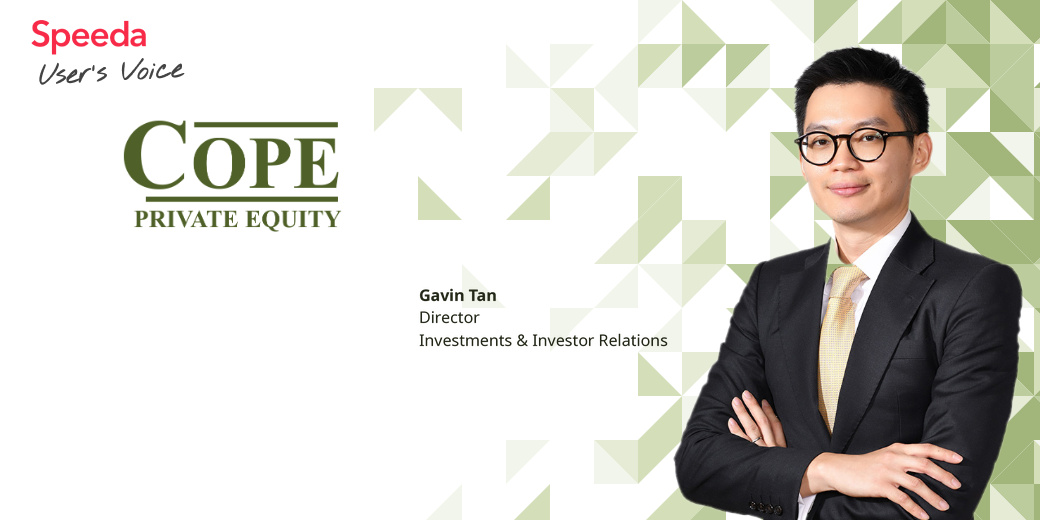
IntroductionIn this edition of Speeda's User Voice, we speak with Gavin Tan, Director, Investments & Investor Relations at COPE Private Equity (hereafter referred to as “COPE”).COPE is one of Malaysia's oldest private equity firms. It has been investing for 20 years and manages about USD 150 million in assets. The firm invests predominantly in Malaysian companies across three sectors: technology, industrial and consumer.COPE is a growth equity investor. "We take minority stakes and we work with entrepreneurs," Gavin explains. The firm has about 18 people and has used Speeda for more than nine years.The challenge: knowing a company's scale before the first conversationFor a PE firm with set ticket sizes, the first question about any opportunity is simple: is this company the right size for us? In Malaysia's private markets, that question used to be hard to answer."Companies reach out to us and we really could not check the scale, their background, their numbers" Gavin recalls. "Because we have certain investment ticket sizes, we would prefer to spend time on businesses at the right scale with the right economics."Early screening was "a bit of guesswork." The team searched records at SSM, Malaysia's companies registry. But access was not easy, searches were case by case and they were time-consuming. The cost fell on both sides: the investors' time and the entrepreneur's.How COPE uses Speeda todaySpeeda now sits at the front of COPE's research process. "With Speeda, you can really speed up the research process, get a background, get a sense of who the people are behind," Gavin says. "From there, we have a more informed conversation."The team uses the platform in three main ways.Screening inbound opportunities. When a company approaches COPE, the team first checks its scale and background against the firm's criteria. Meetings then start with the right companies and with better questions.Zooming into sub sectors for deal sourcing. Within its focus sectors, COPE drills down, for example from consumer into healthcare, and from healthcare into medical devices. Here the team draws on Speeda's sector-specific industry reports and has used them to study areas such as consumer products and confectionery for outbound deal sourcing. Where no report exists, the firm's research quota lets it ask Speeda's consultants for customized research.Sizing the investable universe for fundraising. "When you fundraise, investors care about the investable universe: how big is the market" Gavin explains. COPE uses Speeda to identify companies of a certain scale in its target sectors, across geographies such as Malaysia, Singapore or Thailand. The question is practical: "Given our ticket size, given our team, given our geographical focus, how many companies are there in a certain sector within our range?"Why local private market coverage matters to COPECOPE's team has used global financial data platforms in the past. In Gavin's experience, they tend to be broader in scope and focused on public equity."For us, public equity data is a good-to-have. You use it as a benchmark and you use it for research," he says. "But really what we need is Malaysian private market data, and Speeda gives us great coverage." That coverage also extends across many Southeast Asian countries.Price matters too. Global providers justify their fees with the volume of data they offer, Gavin notes. "But if you don't use these features, is it worth the money?" For COPE's focus, he says, Speeda fits what we need very well."COPE’s perspective on investing in Southeast AsiaWe also asked Gavin what COPE's two decades of investing have taught the firm about private companies in the region. His answers apply well beyond any single platform.Numbers matter, but the people behind the business matter mostFinancials are the starting point: the business, its history, its growth trajectory, margins and products. But in COPE's experience, the key is the people behind the business."Especially as growth equity investors, you partner with the entrepreneur," Gavin says. "So understanding what makes him tick, understanding his ambition, his character, that is very important."That means going beyond desk research to industry checks. Talk to people who have worked with the founder, and to their suppliers and competitors. Legal protections only go so far: "You can draft things in your legal documents, you can check and make sure everything's ok. But if the person's character is problematic, it will be a difficult investment." When problems do arise, Gavin agrees, they generally trace back to the founders.Southeast Asia is not one marketSoutheast Asia is often discussed as one region, but investment conditions differ significantly from country to country. COPE's partners have invested outside Malaysia, and Gavin points to three differences any cross-border thesis should account for. Economic development. Each country is at a different stage, with Singapore the most developed. The industries that work in one market may not work in another, depending on how developed it is. Business norms. Business practices and expectations vary across Southeast Asia. Gavin points to the different historical backgrounds of markets such as Malaysia, Singapore, Indonesia and Vietnam as one factor behind these local differences. Legal systems. Some markets follow common law and others civil law. His advice is to have someone local who understands the market. " If not, you're taking a big risk when you go from one country to the other. It's a bit like stepping into the unknown." As he puts it: "You always learn. But do you want to learn it the easy way or the painful way?""We have been a happy customer of Speeda over the years, and we are grateful for the collaboration," Gavin says.Interview Date: September 25, 2026The content of the interview article, as well as the affiliations and titles of the individuals mentioned, are based on information as of the time of the interview. Interested in researching private companies and investment opportunities across Southeast Asia?Explore how Speeda can support your investment research.
-
This article highlights key findings from Speeda’s “SEA M&A 2Q2026” report. For the full analysis—including country and sector breakdowns, top M&A transactions, startup financing trends, and additional deal-level insights—submit the form to download the complete report.Southeast Asia's M&A market delivered a mixed picture in 2Q2026. Total deal value increased 21.7% QoQ to approximately USD 16.9 billion, even as deal volume declined 12.5% to 210 transactions.The headline numbers, however, only tell part of the story.The increase in value was driven by a relatively small number of large transactions, while cross-border activity continued to account for a significant share of the market. At the sector level, capital also became increasingly concentrated in a few areas, including Utilities & Renewables, Consumer Products and Agriculture.For investors and M&A advisors tracking Southeast Asia, the more relevant question is not simply whether deal activity increased or declined, but where capital is moving and which transactions are driving the change. Here are three developments from Speeda's 2Q2026 Southeast Asia M&A data worth watchingDeal value increased — but a small number of transactions drove the growthThe concentration of value was particularly notable: the top five transactions accounted for approximately 60.6% of total deal value, compared with 46.6% in 1Q2026. Large-scale transactions valued at USD 500 million or more accounted for approximately 76% of total deal value.This concentration was reflected in several of the quarter's largest transactions, including Sembcorp's approximately USD 4.6 billion acquisition of Pioneer Sail Holdings and Latrobe Valley Power Holdings, Olam Group's approximately USD 1.8 billion sale of a stake in Olam Agri, and Flex's USD 1.1 billion acquisition of Electrical Power Products.The implication for deal teams: aggregate deal volume may give an incomplete picture of where M&A momentum is actually building. Looking at the transactions behind the headline numbers provides a clearer view of which assets, sectors and strategic themes are attracting capital.What the full report adds: the complete Top 10 SEA M&A deals, transaction-level details, target and buyer information, deal values, and country and sector breakdowns.Cross-border transactions continued to shape Southeast Asia's M&A marketCross-border transactions accounted for approximately 56.9% of total SEA M&A deal value in 2Q2026, while inter-regional transactions accounted for the remaining 43.1%.More importantly, the value and volume of transactions tell different stories.Outbound deals represented only around 10.5% of total deal volume, but accounted for 37.8% of deal value. The average outbound transaction was approximately USD 289 million—around 6.2 times the average value of inter-regional deals and three times that of inbound transactions.Singapore was a major contributor to this trend. The country accounted for approximately 62.1% of total SEA M&A deal value, with outbound transactions representing 58.1% of Singapore's deal value.For investors and advisors, this makes the direction of capital an important lens alongside deal volume. A country generating fewer transactions can still have an outsized impact on regional M&A if its transactions are larger or increasingly cross-border.What the full report adds: a detailed breakdown of inter-regional, inbound and outbound activity, country-level deal value, and the transactions behind the region's cross-border flows.Capital is concentrating around structural growth themesThe sector mix also shifted significantly in 2Q2026.Utilities & Renewables accounted for approximately 30.3% of total SEA M&A deal value, while Consumer Products contributed another 19.5%. Their respective deal values increased approximately 4.5x and 3.2x QoQ. Agriculture recorded the strongest growth, with deal value increasing roughly 6.1x QoQ.Several transactions illustrate the themes behind these numbers.Sembcorp's acquisition of Australian power assets expanded its exposure to electricity and gas infrastructure, while Flex and BizLink's transactions increased exposure to power distribution and components supporting the AI data-centre ecosystem. Olam Group's stake sale in Olam Agri also highlighted strategic interest in scaled agribusiness platforms linked to food security and supply-chain resilience.At the same time, several traditionally active sectors saw deal value contract sharply, including Logistics & Warehousing, Mining, Consumer Services, and Finance & Banking.For deal teams, the sector-level picture is therefore more useful when combined with the individual transactions driving it. The question is not simply which sectors grew, but which assets and strategic themes are attracting the largest commitments of capital.What the full report adds: sector-level deal value and transaction trends, median deal values and multiples, country-sector comparisons, and detailed transaction examples.What these shifts mean for deal teamsThe 2Q2026 data points to a market where large transactions, cross-border capital and specific structural themes are having an outsized influence on overall M&A activity.For PE/VC investors and M&A advisors, the value of the data is therefore in moving from the regional headline to the underlying transactions: Which sectors are attracting the largest transactions? Which countries are driving regional deal value? Where is capital moving across borders? Which companies and assets are attracting strategic buyers? Which transactions are shaping the competitive landscape?The full report brings these dimensions together across Southeast Asia, providing a more granular view of the transactions behind the quarterly headline numbers.What's inside the full 2Q2026 SEA M&A Report?Download the report for deeper analysis of:SEA M&A trends Deal value and volume trends Large, medium and small transaction mix Cross-border and inter-regional deal flows 3Q26 M&A outlookSector and country analysis Deal value by industry Median deal value and EV/EBITDA by sector Country-level deal activity Singapore's outbound M&A activity Country-sector dynamicsTransaction and dealmaker analysis Top 10 M&A transactions in Southeast Asia Target and buyer information Leading financial advisors Leading legal advisorsStartup M&A Startup M&A by country and sector Funding mix Funding stage Key technology and advanced technology transactionsLooking beyond announced transactions?For investors and advisors, understanding the M&A landscape often requires going beyond transaction announcements to research the private companies, industries and markets behind them.Speeda provides largest coverage of private companies across Asia, helping deal professionals conduct company research, compare industries and investigate potential targets alongside broader market and M&A analysis.Download the full Speeda SEA M&A Report 2Q2026 to explore the data and transactions behind the quarter's activity.
-
Speeda Private Market Snapshot is a one-page industry overview designed to help investment and advisory professionals quickly understand market structure, leading companies, financial benchmarks, and investment activity.Below is a sample Snapshot featuring Malaysia's Semiconductors industry. To explore your target industry across Asia, start a free Speeda trial or request a personalized walkthrough to access detailed data and insights here.Market OutlookMalaysia’s semiconductor sector is a heavily foreign-anchored, privately held market that functions primarily as a crucial back-end assembly, testing, and packaging hub within the global semiconductor supply chain. Powered by Speeda's private market intelligence, the sector comprises 194 identified companies, with 89.2% being privately held and private entities accounting for 94.7% of total reported industry revenue. Revenue is exceptionally concentrated: the top 10 companies account for 75.3% of total reported industry revenue.While Malaysia remains an essential node for global chipmakers, its financial performance trails top regional design and foundry hubs like China on profitability. However, M&A and private deal activity have shown renewed momentum in 2026 YTD, dominated primarily by minority stake investments.This Snapshot is generated based on Speeda, an Asia-focused business intelligence platform.Key Takeaways Foreign MNC subsidiaries dictate market revenue: Private entities account for 94.7% of total reported industry revenue, with the top 10 players generating 75.3%. All top 10 companies (including Intel, Infineon, Texas Instruments, and STMicroelectronics) are privately held subsidiaries of global semiconductor leaders. Malaysia's market structure is unlisted and highly concentrated: Out of 194 identified companies, 89.2% operate privately, anchoring Malaysia as a specialized back-end assembly, testing, and packaging (OSAT) hub rather than a fabless or design-led market. Profit margins lag regional front-end peers: Operating in lower-margin back-end services yields a median EBITDA margin of 12.6% and pretax profit margin of 3.9%. This trails design and foundry hubs like Taiwan (16.3% EBITDA) and Mainland China (16.6% EBITDA), though it remains ahead of South Korea and Singapore. M&A deal activity is driven by strategic minority investments: Between 2021 and 2026 YTD, 64 out of 84 announced deals (76.2%) were minority stake transactions, demonstrating corporate expansion and supply chain integration over full buyouts. Deal value rebounded sharply in 2026 YTD: Following a quiet 2023–2024 period, private investment value surged, driven by large-scale transactions. Data isolates corporate and private capital flows: Investment figures strictly exclude state pension allocations from EPF and KWAP, delivering a clear signal on private market M&A behavior and strategic corporate investments.Methodology & Data CoverageThis Snapshot is powered by Speeda, an Asia-focused business intelligence platform combining private company data, industry insights, M&A deals and expert research.Coverage 12M+ private companies worldwide 580+ proprietary industry classifications with company mapping 3M+ M&A and private investment deals worldwideMethodology Revenue-based analysis includes companies with reported annual revenue of USD 1 million or above. Financial benchmark metrics are calculated using companies with available financial information. Investment activity covers deals announced during 1 Jan 2021 – 31 Jul 2026.Insights Beyond the Snapshot1. Why do private multinational subsidiaries dominate Malaysia's semiconductor market?Malaysia serves primarily as a global back-end assembly, packaging, and testing (OSAT) hub rather than a domestic design or foundry market. Because major global chipmakers establish local operating subsidiaries to handle OSAT and equipment manufacturing, the market's revenue is heavily concentrated—the top 10 companies account for 75.3% of total industry revenue, and all 10 are privately held local entities of foreign MNCs like Intel, STMicroelectronics, and Texas Instruments.2. How do Malaysia’s semiconductor profit margins compare to Asia regional peers?Malaysia’s semiconductor sector operates with lower median EBITDA (12.6%) and pretax margins (3.9%) than Mainland China (16.6% EBITDA) and Taiwan (16.3% EBITDA). This margin variance reflects Malaysia's concentration in labor- and capital-intensive back-end testing and assembly operations, whereas Taiwan and Mainland China capture higher-margin activities in front-end wafer fabrication, foundry services, and fabless chip design. However, Malaysia’s margins remain higher than regional peers like Singapore (-0.5% pretax margin) and South Korea (3.5% pretax margin)3. How is private company data used for transfer pricing in Malaysia’s semiconductor sector?Because 94.7% of industry revenue in Malaysia is generated by privately held entities—mostly operating as related-party subsidiaries—transfer pricing compliance requires screening non-listed private comparables. Tax and advisory teams use private market financial metrics (such as median regional EBITDA and operating margins) to benchmark intercompany pricing for assembly, packaging, and distribution functions against defensible independent arm’s-length peers.4. What are the key M&A and private investment trends in Malaysia's semiconductor ecosystem?Investment activity is heavily skewed toward minority stake transactions rather than full buyouts, reflecting strategic corporate expansion and supply chain partnerships. Out of 84 announced deals between 2021 and 2026 YTD, 64 were minority investments while only 20 were full acquisitions. Excluding state-linked pension allocations (EPF/KWAP) reveals a sharp rebound in private and corporate investment value in 2026 YTD after a quiet 2023–2024 period.5. How can dealmakers and research teams screen unlisted semiconductor targets in Malaysia?Standard public registry codes (SIC/SSIC) often group semiconductor players broadly under general electronics or manufacturing, obscuring niche players. To build accurate target universes or peer comparables, investment professionals use specialized platforms like Speeda to screen private companies by granular activity — such as OSAT services, automated test equipment (ATE), or wafer substrate processing—cross-referenced with reported revenue thresholds.
-
|IntroductionIn "Speeda User’s Voice," we share client stories on how they utilize Speeda to enhance research efficiency and drive business growth.In today’s round, we invited Nomura Research Institute (NRI) Singapore, a leading global research firm, to experience our Expert Research Services (FLASH Opinion & EXPERT Interview) while co-authoring a collaboration article with us. Explore their experience to see how these insights shaped the narrative and hear their candid perspective on the process.🔗 [Read the NRI × Speeda Collaboration Article (English) Here]- What was the background and primary objective for using Uzabase’s services when crafting this collaborative article?We were co-authoring an industry column with Speeda on how Japanese FMCG brands can build fan loyalty in Southeast Asia — covering Vietnam, Indonesia, and Singapore simultaneously. The challenge was that our internal research covered the strategic and analytical layer well, but we needed practitioner validation from people with direct on-the-ground experience in these markets. We used Uzabase's services specifically to stress-test our framework and enrich the recommendations with real execution insight that consulting analysis alone cannot provide.The Two Key Features of "Expert Research (ER)" Used in This ProjectThe FLASH Opinion (FO) Experience- How user-friendly was the Speeda platform interface when submitting your query, and what was your impression of receiving responses within 24 hours?The platform was straightforward to use — submitting the query took minimal effort and the structured format helped us frame the question clearly. Receiving diverse expert responses within 24 hours was genuinely useful given our project timeline. What impressed me was not just the speed but the fact that the responses were substantive and varied enough to surface perspectives we had not anticipated, rather than converging on the same generic answers.- What was your assessment regarding the quality and relevance of the written insights provided by the experts?The quality was consistently high and market-specific. Experts did not give textbook answers — they shared observations grounded in direct experience, which gave us material we could actually use in the column.The EXPERT Interview (EI) Experience- How smooth was the communication and scheduling process with the dedicated Speeda staff leading up to the interview?The Speeda team was responsive and well-organized throughout. Scheduling coordination was handled smoothly and communication ahead of the interview was clear.- How satisfied were you with the initial shortlist of experts, and what was your impression of the depth of knowledge demonstrated by the expert during the 1-hour interview?The initial shortlist was well-targeted to the profile we specified — a senior practitioner with direct SEA market experience across multiple markets simultaneously. The expert we interviewed demonstrated exactly the kind of depth we were looking for: not just strategic familiarity with the markets but specific, named observations from campaigns and brands they had worked with directly.- How did navigating the entire journey—from scoping broadly with FO to diving deep with EI—contribute to the final collaborative article? The two services worked as a genuine funnel. FLASH Opinion gave us breadth - a range of practitioner views across markets that helped us identify which themes were consistent and which were contested. The EXPERT Interview then gave us depth on the most important themes: the execution model, the in-house versus outsource decision, how to recruit and retain local talent, and what Japanese FMCG brands consistently get wrong market by market.- Looking at your overall experience, how valuable was this process, and to whom would you recommend this powerful combination of FO and EI?The combination of FLASH Opinion and EXPERT Interview is genuinely more valuable than either service alone. FO is fast and broad — ideal for validating a framework or stress-testing assumptions across multiple perspectives quickly. EI is deep and specific — ideal for generating the kind of practitioner insight that makes analysis credible and actionable rather than theoretical. Together they gave our column both rigour and authenticity. I would recommend this combination to any consulting team producing thought leadership that needs to be grounded in market reality, particularly for cross-country research where internal expertise is inevitably thinner in some markets than others.Interview Date: July 27, 2026The content of the interview article, as well as the affiliations and titles of the individuals mentioned, are based on information as of the time of the interview.
-
This article was contributed by NRI Singapore. You can also find this article on the NRI website here.The Gap That Is Quietly WideningJapanese FMCG brands have spent long time building distribution in Southeast Asia. Their products are on the shelves. Their brand names are recognized. Yet 90% of Vietnamese consumers switched brands in the past three months (McKinsey, 2023).The problem is not product quality. It is the gap between brand presence and brand loyalty, and three structural forces are widening it: consumers now make identity-driven choices, not access-driven ones;Korean and local brands are winning on emotional connection rather than product superiority; and TikTok-led discovery and live commerce have permanently shifted how purchase decisions are made, rewarding community authenticity over broadcast advertising (Google, Temasek & Bain, 2025).What Winning Brands Do DifferentlyEvery brand that has built genuine fan loyalty in SEA operates on two layers simultaneously.Layer 1 (Commercial Foundation) is the prerequisite: accessible pricing, frictionless distribution, continuous product renewal, and promotional activity. Japanese FMCG brands typically have this in place.Layer 2 (Fan Architecture) is the differentiator: a sharp insight into a specific local consumer identity or community goal, an experiential or participatory execution, and amplification through trusted local channels. The gap for Japanese FMCG is almost entirely here.Three methods exist for building Layer 2, each defined by a different direction of relationship between brand and consumer.Successful Brands That Have Already Done ThisAcecook (Vietnam), Wardah and MILO Van (Indonesia and Singapore), and ASICS (Southeast Asia) each represent a fundamentally different approach to fan building, and together they cover the full range of what is available to Japanese FMCG brands in this region.The first method draws consumers toward the brand by giving them something of the brand's own story to personally claim and extend.On its 30th anniversary, Acecook launched a recipe contest, Acecook Vietnam: 30 Years of Harmonizing with Vietnamese Life, inviting consumers to create dishes using its products and tapping directly into Vietnam's deep attachment to personalizing food. A network of nano food bloggers amplified the results organically. As observed by an independent FMCG consultant who advised on the campaign directly: "The real engine was a network of small food bloggers, not celebrities, who posted their own creations. That sense of ownership turned casual buyers into vocal fans." The consumer insight fed directly back into Acecook's R&D pipeline, including collaborations with Michelin Guide-recognized restaurants and locally sourced ingredient innovations.The second requires the brand to set aside its own narrative entirely and enter the consumer's world on the consumer's terms.Wardah and MILO Van each took this path, not building a new community but entering one that already existed. Wardah embedded itself in the Islamic communitynetworks, campus organizations, and Ramadan events that Indonesian Muslim women already belonged to, becoming Indonesia's largest domestic cosmetics company with the highest brand loyalty index among beauty brands in the country. MILO Van re-entered a ritual that Singaporeans had been carrying privately for decades, the memory of free MILO at school sports days, giving consumers a physical format to express and share that nostalgia publicly. Despite having the second-lowest engagement volume among MILO's SG60 campaign elements, the van activation generated the most emotionally charged consumer responses of any activation tracked. Both cases succeeded for the same reason: the brand understood deeply who its consumers already were and showed up in the spaces those consumers already owned.The third goes further still, asking the brand and consumer to build something together that neither could create alone.The ASICS Running Club, with weekly structured training programs across Singapore, Indonesia, and Thailand, gave communities a collective goal to work toward with ASICS as the enabler. Members who joined in Year 1 became brand advocates in Year 8, at a running cost of approximately SGD 5,000 per quarter. ASICS grew its SEA business from JPY 4.4 billion to JPY 25.5 billion between 2021 and 2025 at a CAGR of 52.9%. As a Speeda expert who served as regional marketing lead at ASICS SEA, explains: "Initially HQ wanted to vet through every single thing. Over time, local teams earned significantly more empowerment. That shift is what made the community building possible." What these three cases reveal is a systematic logic. Acecook invited consumers into its own world by making its origin story something consumers could personally claim and extend, so that the brand reflected who they are as individuals Wardah and MILO Van went the other direction, bringing the brand into the world consumers already inhabited and succeeding because they understood deeply who their consumers already were ASICS did both simultaneously, co-creating a community with shared goals that made leaving the brand mean leaving the community itself.Together the three methods cover every direction of brand-consumer relationship, and Japanese FMCG brands have the product credentials, cultural heritage, and craft story to execute all three.*How can you leverage "real expert insights" like the above in your business? Read about how NRI Singapore, the contributor of this article, utilized the Speeda Expert Research Service [here].From Method to Execution: The Sequence Every Brand Must FollowWhichever method a brand pursues, the execution always follows the same three-stage sequence. The method determines the direction of the brand-consumer relationship. The sequence determines the order in which that relationship is built. Skipping a stage, regardless of method, produces content without community trust.Stage 1: Earn Relevance.The brand must first answer one question for a specific consumer segment: does this brand speak to who I am? In Vietnam, the most accessible entry points are urban stress and restoration, and self-improvement as personal identity, both underserved by Japanese FMCG despite strong product fit. In Indonesia, functional and clinical credibility positioned as a shared identity is the most accessible anchor, given that Japanese brands carry deeper safety and quality credentials than most competitors. In Singapore, Japanese craft heritage expressed as a specific design philosophy rather than a generic quality label already has an engaged audience waiting to be activated.Stage 2: Create Belonging.Once relevant, the brand needs a recurring reason for consumers to gather around it. The first activation builds awareness. The third builds habit. The tenth builds loyalty. A seasonal campaign is not Stage 2. A program that shows up consistently, whether weekly, monthly, or annually, is.Stage 3: Enable Amplification.Peer community development through community influences, incl. trusted nano and micro content creators is the primary amplification mechanism across all three markets.Relationship building must come before any paid brief. Brands that brief community influences before building genuine relationships receive content without community trust, which is the Stage 3 failure mode most Japanese FMCG brands fall into by default.How to ExecuteThe strategic case is clear. Execution is where most brands stall. Three practical starting points from direct practitioner experience across all three markets:First hire.Bring on a Community Manager who is already a genuine, active member of the target community. This is not a social media manager or a content scheduler, but someone known and trusted in that space before the brand arrives. The most effective way to find this person is through community referral, not job postings.Outsource vs. in-house.Outsource for the first one to two years as it is faster and cheaper at entry stage. Keep community management and KOL relationships in-house from the start because these are trust-based and the relationship equity must belong to the brand, not the agency. Production, event logistics, and paid media are better outsourced to specialists.Agency selection.Three criteria matter. Business results, specifically community growth metrics and repeat purchase uplift rather than influencer headcount Local relevance, meaning genuine sub-market understanding given that Indonesia is not one market and HCMC and Hanoi are not interchangeable Operational excellence to show how the agency cares and acts at speed and qualityOn budget, a pilot in SEA covering one market and one segment typically starts from USD 40,000. A mid-market rollout runs between USD 150,000 and USD 500,000. A full national program requires USD500,000 and above.References1. McKinsey & Company (2023). Vietnamese consumers are coming of age in 2023: How businesses can stay ahead.URL: https://www.mckinsey.com/featured-insights/asia-pacific/vietnamese-consumers-are-coming-of-age-in-2023-how-businesses-can-stay-ahead 2. Google, Temasek & Bain & Company (2025). e-Conomy SEA 2025: From Digital Decade to AI Reality.URL: https://www.bain.com/insights/e-conomy-sea-2025/ This report incorporates expert insights obtained through Speeda Expert Research Service to enhance the analysis and discussion.Click [here] to read a testimonial from NRI Singapore on their experience using this service.
-
Emerging themes from investor and advisory conversationsAs deal activity and strategic investments continue to evolve across Southeast Asia, investors, consultants, and corporates are increasingly seeking deeper, real-time insights to inform their decisions.Following the integration of Sealed Network into the Uzabase group, Speeda has expanded its capabilities to provide on-demand access to industry experts alongside its existing data and market intelligence platform (Speeda). This combined approach enables more nuanced understanding of sector dynamics, especially in fast-moving or opaque markets.Below, we highlight some of the recent questions raised by market participants, using the data center sector as an example to illustrate how expert insights can support investment and consultants workflows.How expert insights translate into real-world decision-makingTop industry questions & Example of expert responses Recent inquiries from private equity firms, consulting teams, and corporates have focused on areas such as data center. To address these questions, expert consultations can provide practical, experience-based perspectives.Expert background: Ex-Microsoft, Former Sub-regional Planning Lead – DC EPC Project Controls How are HVAC decision-making responsibilities split between owners/operators, MEP consultants, EPCs and integrators across project stages? "I work closely with owners/operators on cooling strategy definition, align MEP consultants during concept and DD, and support EPCs and system integrators through constructability, procurement, and commissioning—decision rights typically shifting from owner-led strategy to EPC-led execution post design freeze." How do HVAC procurement workflows differ for hyperscale new builds, colocation expansions and live retrofits from spec freeze to PO? "Hyperscale new builds follow early vendor engagement with long-lead lock-ins at 30–60% design, while collocation expansions and retrofits compress timelines with later freezes; PO issuance generally follows spec freeze, commercial alignment, and site-specific risk clearance." How do power availability, PUE targets, energy costs, sustainability needs and permits shape cooling architecture across DC types? "Cooling architecture is primarily shaped by power availability and PUE targets, with energy cost, sustainability commitments, and local permitting constraints driving trade-offs between air, hybrid, and liquid solutions—especially pronounced in expansions and retrofits." What are typical HVAC scopes and CAPEX per MW of IT load by DC type, and how do air, hybrid and liquid cooling solutions compare? "HVAC CAPEX typically scales per MW of IT load and varies materially by cooling architecture, redundancy philosophy, and delivery model, with air systems at the lower end and liquid or hybrid solutions carrying higher integration and balance-of-plant costs." Key technical, commercial and reference criteria for HVCA supplier qualification and selection "Supplier selection balances proven reliability, efficiency, and delivery capability for core equipment, while emerging solutions like liquid cooling place greater emphasis on system integration clarity, reference deployments, and operational risk mitigation. "Supporting investment and strategy with expert insightsAcross Asia, access to deep subject matter insights is becoming increasingly important for: Commercial due diligence and market validation Deal sourcing and investment thesis development Operational benchmarking and value creation planning Corporate strategy and market entry assessmentsBy combining proprietary data with direct access to industry experts, Speeda supports more informed and timely decision-making. Explore how expert insights can support your projects, please submit the form to talk to us.
-
M&A Leader’s Edge: Transforming Market Intelligence -Optimizing Private Market Analysis with Speeda-
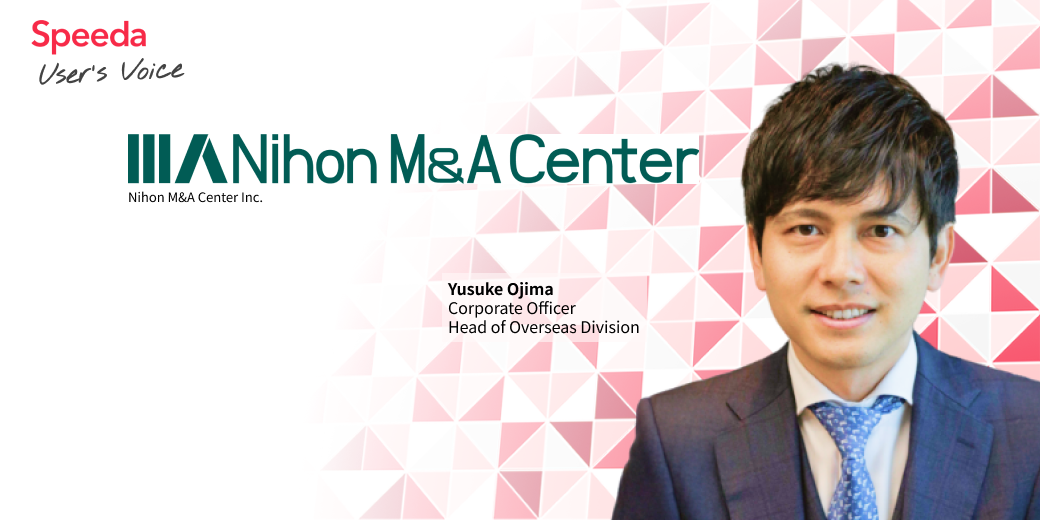
|IntroductionIn this edition of Speeda’s User Voice, we are honored to feature Mr. Yusuke Ojima, Corporate Officer and Head of the Overseas Division at Nihon M&A Center Inc.Nihon M&A Center is Japan’s leading independent M&A brokerage firm, specializing in "friendly M&A" for small and medium-sized enterprises with a vast track record both domestically and internationally.As 2026 marks the 10th anniversary of its global expansion, the firm has come a long way since its "zero-to-one" journey began in Singapore. Today, it has grown into a regional powerhouse of over 60 professionals across Malaysia, Vietnam, Indonesia, and Thailand.This decade of growth represents more than just a business expansion; it reflects a commitment to building a vital bridge between Japan and ASEAN. Under Mr. Ojima’s leadership, the firm continues to foster "mutual prosperity" and regional development through strategic cross-border M&A.Speeda is proud to share Mr. Ojima’s insights on leveraging our platform to navigate Southeast Asia’s fragmented markets and opaque private company landscape, as well as his vision for the future of market intelligence.Expanding M&A in ASEAN: Business Growth and Key StrategiesCould you tell us about your company’s business and your current role?Mr. Ojima: Nihon M&A Center’s overseas business has established bases in five countries: Singapore, Indonesia, Malaysia, Thailand, and Vietnam, and is expanding in South Korea through investments. Additionally, we have joined alliances to handle M&A cases in Europe and the United States. We focus particularly on the ASEAN market, with over 50 employees in our overseas business, closing more than 10 deals per year and handling over 150 cases annually, steadily growing since our overseas expansion.The Singapore office was established in 2016, while the other offices were set up during the COVID-19 pandemic. Since 2022, our business performance has been steadily expanding, targeting not only Japanese companies but also buyers from Europe, the U.S., and ASEAN. Our Singapore office also covers cases in other countries, collaborating with teams in each region to proceed with negotiations.Currently, as the General Manager overseeing our five Southeast Asian offices, I am responsible for overall management. We aim to establish our Indonesian subsidiary by the end of the year, while also increasing personnel across all offices. Strengthening local recruitment and talent development is a key strategy for further growth.Note: This interview was conducted in February 2025. The title and information are current as of that time.Speeda’s Role in Target Selection and Market ResearchHow many people in your company use Speeda, and what roles do they perform? Additionally, what kind of research do you conduct using Speeda, and which specific features do you utilize?Mr. Ojima: All consultants in our overseas sales offices use Speeda. We primarily use it to identify key players within each industry and to narrow down potential targets.We sometimes receive broad requests from Japanese companies such as, "Please introduce M&A opportunities in this industry within this country." By applying filters in Speeda, we can narrow down prospects, making it an essential tool for target selection and list creation.In our line of work, starting from the buyer's demand alone is ineffective, as approaching companies with no intention of selling rarely leads to success. Therefore, we often focus on finding sellers. For example, we frequently reach out to elderly business owners considering retirement who are open to M&A as a means of further growth.We use Speeda’s industry player lists before approaching potential sellers, making it an invaluable tool for our initial contact. Additionally, information such as the founding year and executive profiles is particularly useful. Since we generally do not approach very young companies, having access to company age data is extremely helpful.What led you to start using Speeda?Mr. Ojima: We had been using Speeda in Japan, and as the number of national staff in Singapore increased, we decided to adopt it locally as well.Could you share Speeda’s strengths and weaknesses compared to other services?Mr. Ojima: Speeda provides a vast amount of market information. It not only covers industry players but also offers extensive data across various industries, making it convenient for obtaining market insights.When Japanese companies progress in negotiations, they often request specific market information about the country in question. However, reliable market data for Southeast Asia is scarce. Among the available options, Speeda offers one of the most comprehensive datasets.If I had to point out a limitation, it would be that having access to market growth rates and market size data would be even more beneficial. Growth rates are crucial indicators for company valuation, so having this data readily available would be highly valuable. Currently, we rely on expensive reports from Western research firms or estimates based on past growth rates when data is unavailable.If there are cases where you do not understand the logic behind certain market size figures, we can offer research services to construct logical assumptions and provide estimations based on specific premises.In September 2023, your Singapore office requested research on the Singapore construction market. Could you share more details about this?Mr. Ojima: We occasionally made similar research requests when we had Speeda contracts in Japan as well. We often receive inquiries from clients asking why Singapore, why its construction industry, and how it compares to other countries. Given the importance of understanding market indicators across Southeast Asia, we likely made this request to compile key market metrics.Key Research Factors for M&A in Southeast AsiaWhat aspects of M&A research are particularly crucial in the Southeast Asian market?Mr. Ojima: While this varies by country, financial information is extremely important. Typically, if financial data is unavailable, we need to sign an NDA (Non-Disclosure Agreement) to obtain it, which requires significant time and effort.Even if only partial or highlighted financial data is available, it serves as a crucial conversation starter, improving efficiency and reducing the time required for discussions.What advice would you give to those considering starting to use Speeda?Mr. Ojima: The ability to access market information from overseas and identify key industry players is invaluable. While M&A is just one component of corporate planning and growth strategies, Speeda is also useful for joint ventures, business matching, and competitive analysis.Currently, many M&A advisors exist, but I believe more corporate teams will start utilizing M&A internally as a strategic tool. Having access to a database like Speeda, which companies can use themselves, enhances productivity and makes the process more efficient.Thank you very much for your time today and for sharing your insights during the interview session!Interview Date: Janurary 27, 2025The content of the interview article, as well as the affiliations and titles of the individuals mentioned, are based on information as of the time of the interview.|Speeda: Accelerating Your Research SolutionsExperience the power of efficient research with Speeda – your go-to platform for comprehensive industry insights and strategic decision-making.Schedule a free demonstration call with our team and see how our data solutions can elevate your business intelligence capabilities.






Solutions to support your research work
As a one-stop platform, Speeda offers various features to accelerate desktop research efforts. Search for the information you need within the comprehensive contents and obtain it in your desired format, allowing you to focus more on your analysis work to concentrate on making successful decisions. Speeda accelerates desktop research for professionals engaged in deal sourcing, target scheming, competitor analysis, strategic planning, value creation, marketing, business, development, and more.

Private and Public Company Data
Streamline your research with targeted filters to accelerate your work for company data selection.

Industry Reports
Quickly grasp market dynamics with reports written by region for comprehensive insights.

M&A, Fundraising Deals Database
Gather information from M&A deals and fundraising activities records for your decision-making.

Global News
Keep abreast of the business world with the latest news articles and custom alerts for strategic awareness.

Expert Network Service
Connect with the experts and tap into their knowledge to enrich your analysis and insight.

On-demand Consulting Service
Save time on niche research with customized reports delivered by our in‑house consultants.
Who we Serve
Private Equity
Venture Capital
Private Equity Venture Capital
Private Equity firms investing in ASEAN choose Speeda for the extensive private companies data and in-house industry reports to assist their target screening and industry analysis.
M&A Advisory
M&A Advisory
From botique advisory firms to advisory teams in consulting firms that focuses on ASEAN, Speeda can assist with target screening, industry research, and more.
Tax Advisory
Tax Advisory
Tax Advisories can efficiently prepare transfer pricing documentation for benchmarking or comparable analyis.
Banks
Banks
Speeda is utilised in various departments such as corporate banking, investment banking and corporate strategy to efficiently gather company data and perform industry research.
Consulting
Consulting
Management consulting, strategy consulting and market research firms can utilise Speeda to perform competitive analysis, benchmarking, and understand the clients' industries efficiently.
Government
Agencies
Government Agencies
From trade agencies to investment promotion agencies, Speeda assists with industry research and gathering key business information of companies by sector and region.
Corporations
Strategic Planning
Corporations
Strategic Planning
Strategy professionals use Speeda for competitor benchmarking, industry/innovation trend monitoring, and desktop research for the initial part of new market-entry or business development projects.
Corporations
Sales Development
Corporations
Sales Development
Sales and Marketing teams can perform market research, target listing (by using multiple criteria) and KYC (Know Your Customer) activities via Speeda, particularly for expansion in ASEAN region.

Client Testimonials







Frequently Asked Questions



What is Speeda, and how does it benefit business and financial professionals?

Speeda is a comprehensive market intelligence research platform designed to empower business and financial professionals. It streamlines the process of collecting company information, provides insights into industry overviews and trends, and ultimately accelerates the decision-making process. By saving time and reducing research-related costs, Speeda enhances efficiency and effectiveness in daily tasks.
What region does Speeda cover?
Speeda offers comprehensive coverage of the South East ASIA (SEA) regions, offering a wealth of data on public and private companies, in-depth market reports, insights into M&A deals, and the latest news update. We have clients from various regions including Singapore, Malaysia, and Vietnam, who rely on Speeda for unparalleled market intelligence and strategic insights to drive their success.
What tasks can Speeda assist with?
Speeda is a versatile platform that supports a wide range of tasks, from company profiling and benchmarking to deal sourcing, target screening, and industry research. Our internal software serves as a one-stop solution for all your business research and company valuation needs in the SEA region.
Can Speeda assist in identifying potential business opportunities?
Absolutely. Speeda's comprehensive database enables users to source deals and monitor news, helping identify potential business opportunities. It is a valuable tool for staying informed about market dynamics.
Can I customise the data I receive to match my specific business needs?
Certainly, our platform offers customisation options for the data you receive. You can define parameters such as location, industry classification, financial metrics, and keywords. This flexibility ensures that the information you receive is relevant and aligned to your business needs.
What sets Speeda apart from other research platforms?
Speeda provides extensive coverage of private and public company data, industry reports, and news specialising in the South East Asia region. This makes Speeda an invaluable resource for business and financial professionals in countries like Singapore, Malaysia, and Vietnam, empowering them to stay ahead in the dynamic landscape of SEA's market.
Is there a demo or trial period available?
We offer a brief trial period that allows you to explore the available options and experience the effectiveness of Speeda firsthand. Apply for a free trial today to get started.

Founded in 2008 and listed in Tokyo in 2016, UZABASE is a fast-growing tech company providing a foundation of intelligence that supports the needs of business and business. We compile, distil, and analyse global information to empower users to make timely data-driven decisions, unleasing their creative and innovative potential.
Uzabase Asia Pacific Pte. Ltd
Twenty Anson #11-01, 20 Anson Rd, Singapore 079912
 speeda.sea@uzabase.com
 Other Offices
Tokyo Headquarter
Uzabase Inc
Mitsubishi Building, 2-5-2 Marunouchi, Chiyoda-ku, Tokyo, 100-0005, Japan
China
Uzabase China Limited
Room 1601, No.688 Nanjing West Road, Jing`an District, Shanghai
Sri Lanka
Uzabase, Inc. Sri Lanka Office
Level 17, Access Towers II, 278/4, Union Place, Colombo 02., Sri Lanka
USA
Uzabase USA, Inc.
211 East 43rd St. Suite 637 New York, NY 10017
