

 spasia_lm@uzabase.com
Resource Center
Singapore vs Malaysia Data Centers: Mapping the Private Market
This article combines Speeda’s private company data with findings from Speeda’s original reports on Southeast Asia’s data center market, bringing the regional market shift into focus through a company-level view.
Singapore remains established. Malaysia is becoming the expansion market
Southeast Asia’s data center market is entering a new phase of expansion, but the opportunity is increasingly moving beyond established hubs.
In recent Speeda report <Capacity Unleashed: Southeast Asia’s Data Centre Boom>, Southeast Asia’s data center capacity could grow at a 35% CAGR from 2023 to 2028. Singapore currently accounts for the largest share of regional capacity, while Malaysia and Indonesia is projected to overtake Singapore as the region’s largest market by 2028. Johor is a major beneficiary of this shift, supported by land availability, infrastructure and proximity to Singapore.
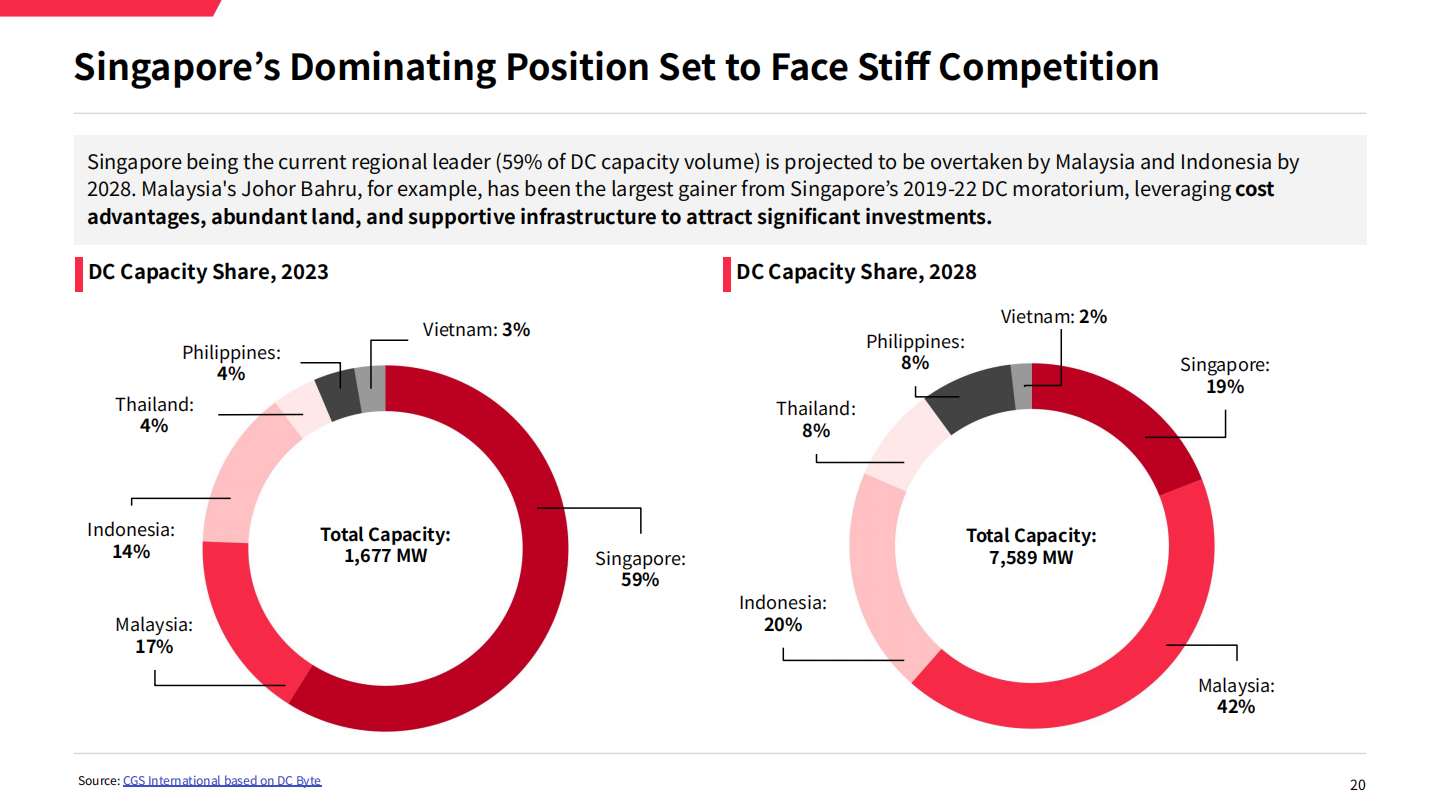
But capacity figures only show one side of the market. For investors, advisors and market researchers, the more practical question is: Who are the private companies behind this expansion?
Mapping the private company landscape
Using Speeda’s company data, we screened companies across relevant server hosting/colocation industries and local industry classifications(SIC), then reviewed company-level business descriptions to identify entities directly involved in data center operations, development or colocation.
This produces a different view from a conventional market report.
Singapore: a deeper established operator base
Our screening identified 46 private Core Data Center* entities in Singapore, combining reported financial data available in Speeda.
The largest companies by reported revenue include (part):
| Company | Reported revenue |
| ST Telemedia Global Data Centres | ~US$1.24bn |
| Equinix Singapore | ~US$700m |
| AirTrunk Singapore | ~US$172m |
| Nxera DCW | ~US$144m |
| STT Loyang | ~US$114m |
*Core Data Center means entity-level evidence indicates that the company owns, operates, develops, or provides physical data center/colocation facilities.
The list also includes Princeton Digital Group, Iron Mountain Data Centre, Cyxtera, Keppel DC, Sandhill Solution and other private entities.
This makes Singapore particularly useful for peer benchmarking and company-level research: the market contains a relatively mature group of identifiable private operators with financial information.
Malaysia: fewer established private operators, but a rapidly expanding pipeline
Malaysia’s private company universe is smaller in our screening, with 23 Core Data Center entities identified and added reported financial data available in Speeda.
The financial data reveals a different profile (part):
| Company | Reported revenue* |
| AirTrunk Malaysia | ~US$430m |
| DayOne Data Centers Malaysia | ~US$152m |
| AIMS Data Centre | ~US$69m |
| Bridge Data Centres Malaysia | ~US$41m |
| Princeton Digital Group SGPlus Two | ~US$20m |
Malaysia’s market is therefore not simply a collection of new project announcements. There are already private operators with meaningful reported financial scale.
The development pipeline, however, is expanding much faster than the established company base.
The Singapore–Johor relationship matters
The distinction between the two markets is not simply “Singapore versus Malaysia.” The two markets are increasingly interconnected.
Singapore offers connectivity, an established digital ecosystem and a mature financial and business environment. Malaysia, particularly Johor, provides greater room for large-scale development.
Speeda’s research on Southeast Asia’s data center market describes this as an emerging SMI triangle, with Singapore serving higher-value, high-density infrastructure while Malaysia and Indonesia offer greater space and cost advantages for hyperscale development.
The Johor-Singapore relationship also means that company research should not always be conducted on a country-by-country basis. Operators can have different entities, projects and investment structures across the two markets.
For example, Speeda’s company data and industry insights can help researchers move from: Market → country & industry → company → financials, rather than relying solely on project announcements or market-capacity estimates.
What does the private market actually look like?
The comparison highlights three differences:
Singapore
- Larger established private-company universe
- More companies with usable financial data
- Greater presence of mature operators and colocation businesses
Malaysia
- Smaller current private-company universe
- Fewer companies with reported financials
- Rapidly expanding development activity, particularly in Johor
For investors and advisors, this creates different research priorities.
Singapore may offer a stronger universe for peer benchmarking and operating-company analysis.
Malaysia may offer greater interest for market mapping, new-entrant identification and expansion tracking.
Want to identify the companies behind your target industry? Explore private company data in Speeda by apply free trial in below.
- Recommended Content