


Solutions
Vietnam’s Semiconductor Expansion: Which Companies are Capturing the Next Layer of Growth?

Vietnam’s semiconductor story is becoming more substantial — but investment announcements reveal only part of it. Behind the new facilities and expansion plans sits a company landscape spanning chip development, engineering services, packaging and specialized materials. These businesses differ considerably in scale, commercial progress and exposure to the industry’s next phase.
For investors and advisers assessing the market, the more consequential question is where value is taking shape: within domestic technology businesses, foreign-led manufacturing operations, or the supporting suppliers needed to connect them.
The Speeda report examines that landscape through industry analysis, investment projects and company profiles, including revenue where available. Its findings point to an ecosystem expanding unevenly—and a supporting layer that has yet to catch up.
Expansion is Outpacing the Supporting Ecosystem
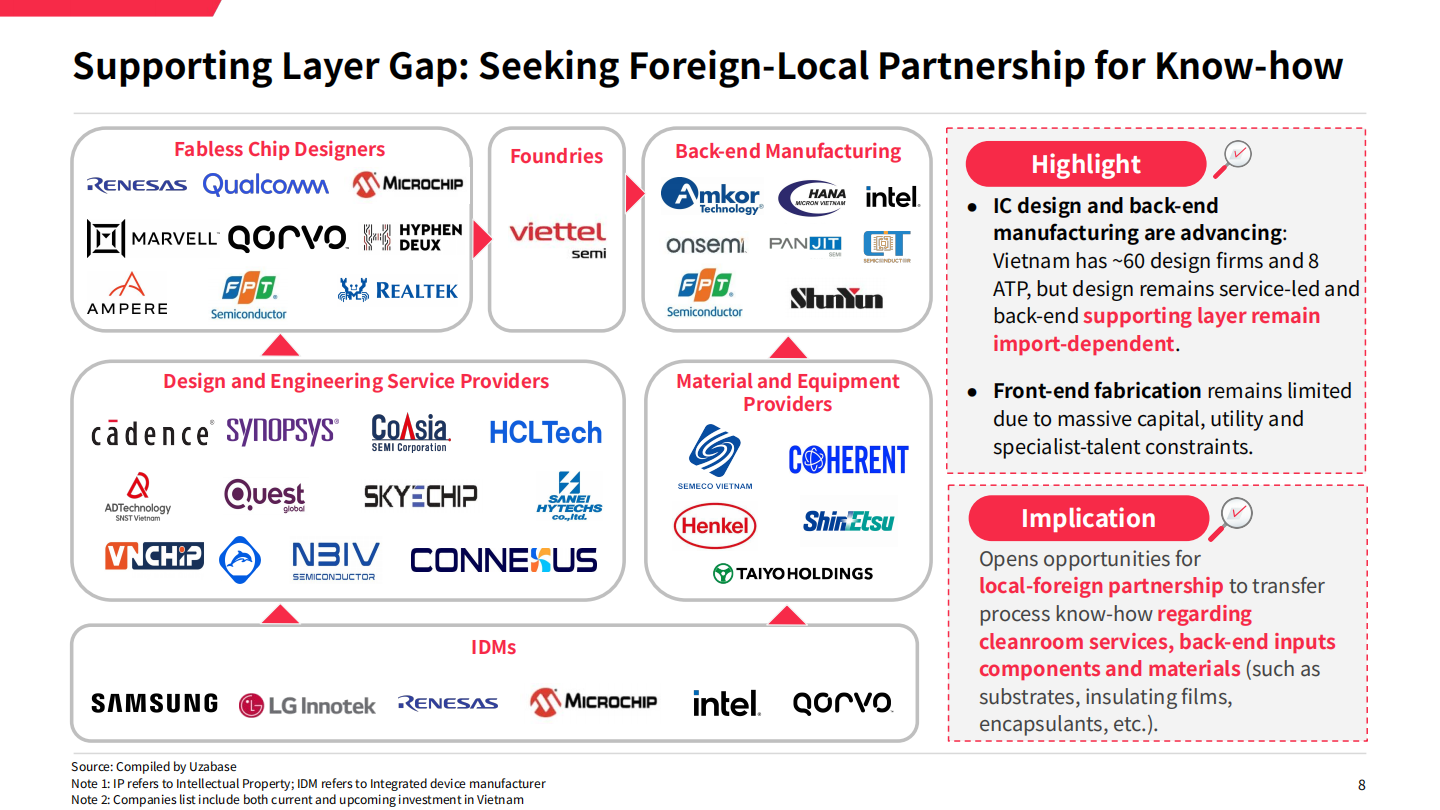
Vietnam has approximately 60 integrated-circuit design firms and 8 assembly, testing and packaging plants. Its established electronics manufacturing base has supported semiconductor development, while demand linked to AI, high-speed networking and data centers is drawing attention towards advanced packaging, chip design and R&D.
The supporting ecosystem remains less developed. The Speeda report identifies limited domestic-scale capabilities in substrates, chemicals and semiconductor equipment, alongside continued dependence on imported back-end inputs.
That imbalance shifts the focus beyond the largest factory announcements. Cleanroom services, specialized components, equipment servicing and packaging materials form part of the supporting layer highlighted in the report. The research question is which businesses already possess relevant capabilities—and how far those capabilities have translated into commercial activity.
Domestic Players are Following Different Commercial Paths
FPT and Viettel illustrate the breadth of Vietnam’s domestic semiconductor ambitions, but their trajectories are distinct.
FPT combines fabless chip development with an expansion into assembly, testing and packaging. The report records 70 million chip orders through 2025 and a phased plan for testing capacity and advanced packaging. Viettel’s activities center on chip design for systems and equipment, with a 32-nanometre fabrication facility targeting trial production from 2028.
Alongside these flagship businesses, the Speeda report profiles smaller local players developing customized chips, thermal-imaging sensors, semiconductor intellectual property and design services, as well as two local outsourced assembly and test providers, including an advanced-packaging lab-fab in Da Nang.
Two entries illustrate the range: the report records 2025 revenue of USD 6.5 million for a local fabless ASIC and AI-platform developer and USD 1.4 million for a design and engineering-service provider. These snapshots bring smaller operating businesses into view, beyond the investment commitments dominating public discussion.
For private market research, the distinction between proprietary technology, service delivery and manufacturing expansion is central to the company story. So is the separation between realized activity, reported orders and future capacity.
Foreign Investment is Broadening the Landscape
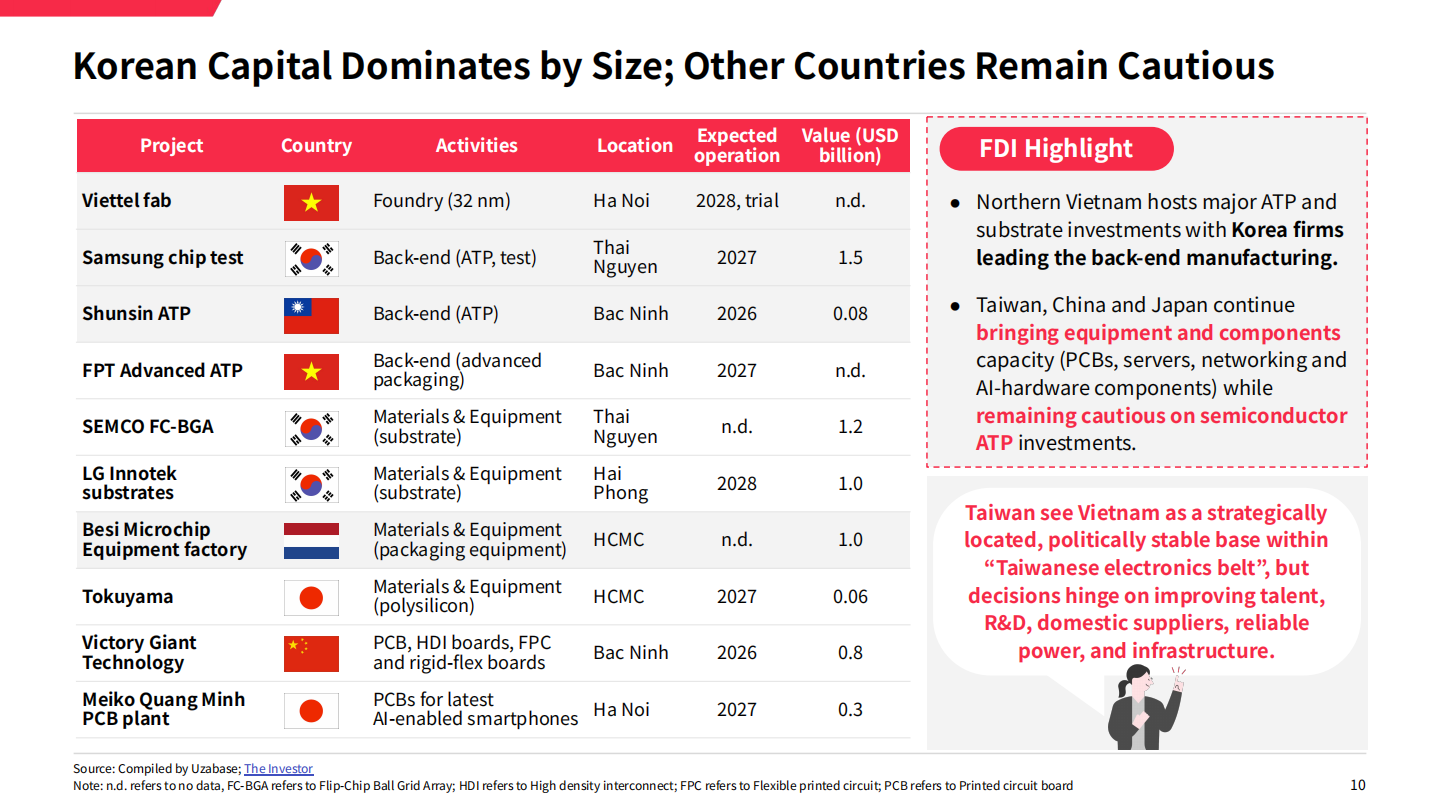
Foreign participation extends beyond packaging and testing. The report maps operations across chip design, engineering services, substrates, encapsulants and other materials, alongside back-end manufacturing.
Its project overview includes foreign investment in semiconductor substrates, packaging equipment, chip assembly and testing, alongside domestic projects such as FPT’s advanced-packaging plant and Viettel’s fab. The northern cluster of Bac Ninh, Thai Nguyen and Hai Phong is the primary back-end and substrate hub, while Hanoi anchors domestic technology development around Viettel’s fab. Ho Chi Minh City combines its role as the IC design core with a second assembly and test node, and Da Nang is developing as an R&D and IC-design hub.
The resulting landscape is more varied than a list of semiconductor plants suggests. It includes established operations, recently announced projects and companies serving both semiconductor and wider electronics markets.
For investors, foreign operations provide context for assessing the ecosystem around domestic businesses. For advisers, they broaden the company research universe. Neither perspective warrants assuming supplier relationships or investment accessibility that the report does not establish.
Company Financials Reveal Scale — but Coverage Remains Uneven
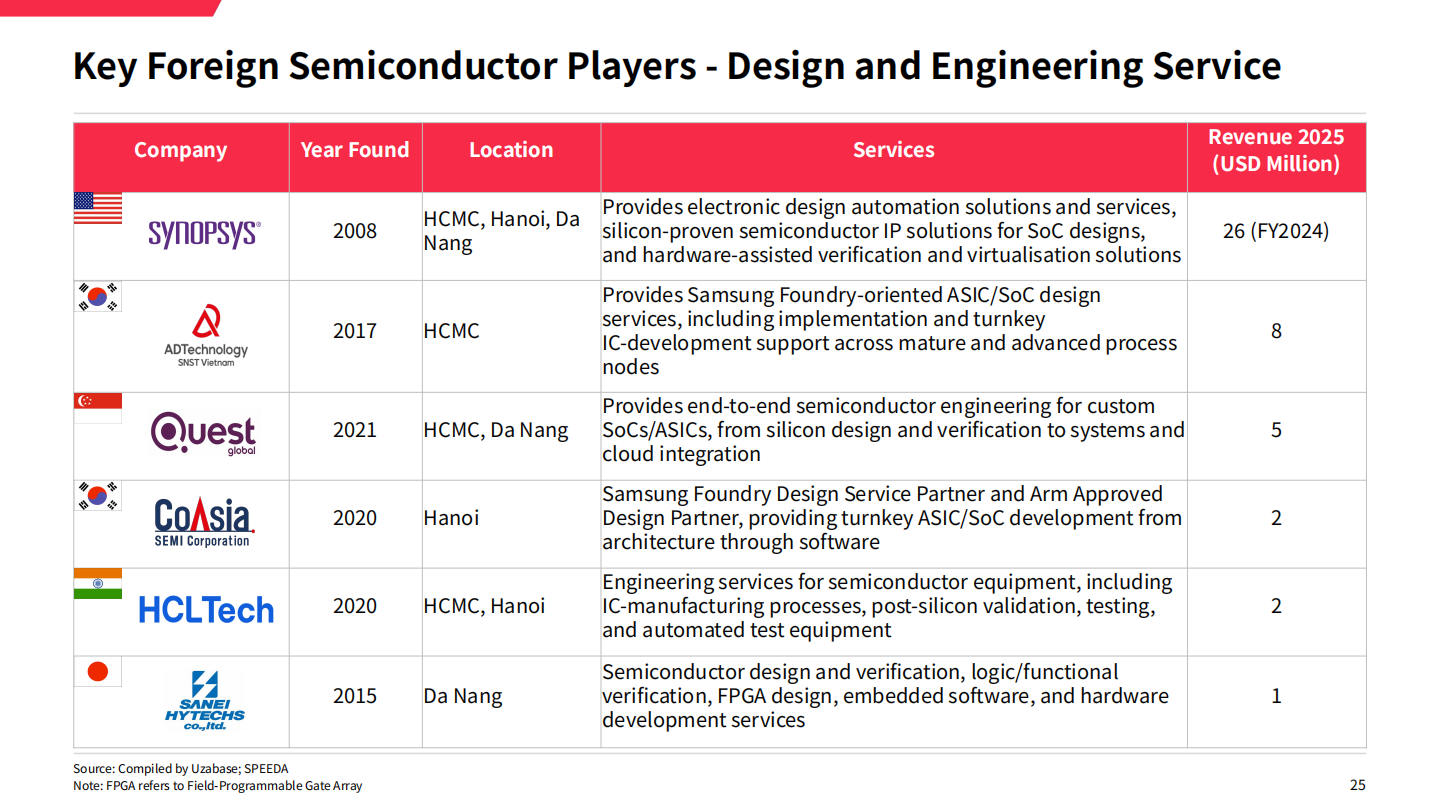
The report’s company tables put financial scale alongside business descriptions. Revenue in the tables ranges from single-digit millions among some design and engineering operations to more than USD 1 billion among larger manufacturing and component businesses.
The detail matters as much as the headline figure. Some companies have diversified activities, so their revenue cannot automatically be attributed entirely to semiconductors. Financial years also vary across selected entries, and revenue is unavailable for several businesses.
These differences make the tables useful for identifying where deeper research is warranted, rather than constructing a single ranking across the ecosystem.
For Vietnam’s transfer pricing practitioners, the profiles offer another entry point: detailed activity descriptions across design, services, materials and manufacturing. However, the report does not establish an independent comparable company set or provide a completed profitability benchmark.
The Next Question is at Company Level
Vietnam’s semiconductor expansion is moving beyond its initial foothold, but the transition is not uniform. Domestic developers, engineering-service businesses, foreign manufacturers and supporting-material suppliers occupy different positions within it.
The next layer of research concerns the businesses behind those positions: their operating activities, reported financial scale, development milestones and the gaps that remain between announced ambition and commercial execution.
Speeda’s report connects that company detail with the wider industry trajectory, allowing readers to examine the ecosystem beyond headline investment totals.
Explore the Full Company Landscape
Download Speeda’s full Vietnam semiconductor ecosystem report to explore:
Local and foreign company profiles across key value-chain segments.
Business activities, locations and revenue where available.
Investment projects, announced values and expected operating timelines.
Supporting-layer gaps, Vietnam’s “C = SET + 1” strategy and FDI incentives, and the talent, power and trade constraints shaping further expansion.
Thank you for your submission!
We will send an email with the download link to access the report shortly.

 spasia_lm@uzabase.com
 Follow our Linkedin Page !

Our latest updates on
ASEAN reports and webinars are posted here.
- Recommended Content












Thank you for your submission!
We will send a follow-up email shortly. Please check your inbox.
spasia_lm@uzabase.com Follow our Linkedin Page !
Our latest updates on
ASEAN reports and webinars are posted here.