


 spasia_lm@uzabase.com

Data Insights
Speeda Private Market Snapshot | Vietnam Electronic Parts Overview (2026)
Speeda Private Market Snapshot is a one-page industry overview designed to help investment and advisory professionals quickly understand market structure, leading companies, financial benchmarks, and investment activity.
Below is a sample Snapshot featuring Vietnam’s Electronic Parts industry. To explore your target industry across Asia, start a free Speeda trial or request a personalized walkthrough to access detailed data and insights here.
Market Outlook
Vietnam’s electronics manufacturing base is benefiting from strong export demand. Speeda’s Vietnam Country Report 3Q26+ shows real GDP grew 10.0% year on year in 3Q26, with manufacturing up 12.3% and accounting for 26.5% of real GDP. The report links this growth to technology exports amid global investment in AI, data centres and semiconductors — which raises an important question for electronic parts: how much of this growth reaches the wider supplier base?
Foreign investment continues to anchor the industry. Foreign-invested companies exported USD 350.4 billion in the first nine months of 2026, or 80.7% of Vietnam’s total exports. Capacity is still being added: Samsung Electro-Mechanics is investing about USD 1.7 billion to expand FCBGA substrate production at its Vietnam subsidiary for AI servers, high-performance computing and automotive electronics, while Molex has completed the first phase of its expanded Hung Yen plant.
Export growth also pulls in imported inputs. In 3Q26, imports rose 42.1% year on year, faster than exports at 30.4%, reflecting heavy reliance on imported manufacturing inputs. Domestic firms remain concentrated in lower-value activities, and the government is moving to link FDI incentives to technology transfer, domestic procurement and supplier upgrading. The report also flags downside risk if global technology investment slows. For investors and advisory teams, the question is not only how fast exports grow, but which businesses can capture more of the value chain — and where the company-level data shows a different picture from the headline export story.
 This Snapshot is generated based on Speeda, an Asia-focused business intelligence platform.
Key Takeaways
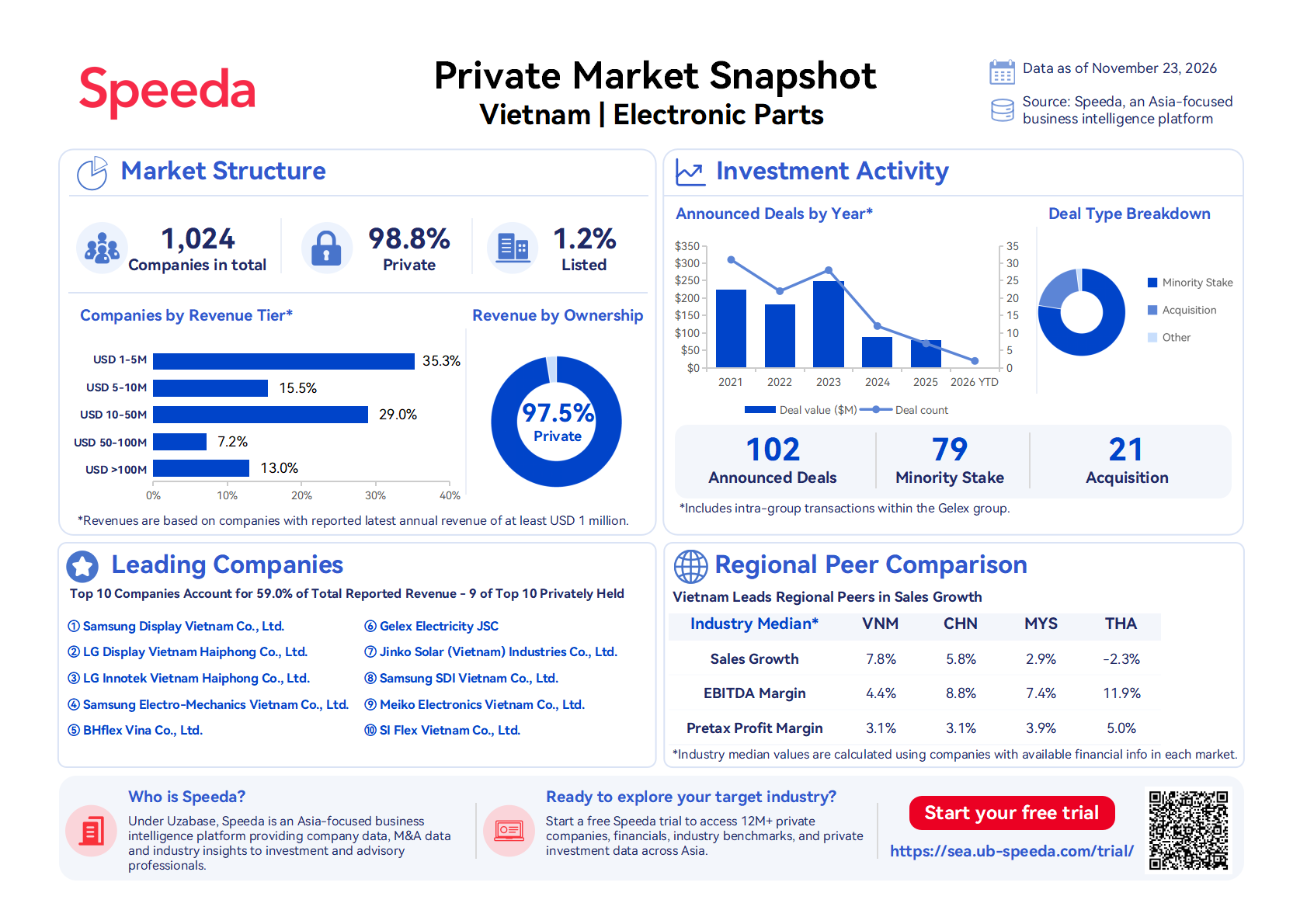
- Private companies dominate the research universe: 98.8% of the 1,024 identified companies are privately held, generating 97.5% of total reported revenue. Private-company coverage is essential to understanding the industry.
- Revenue is concentrated in a small group of large operators: The ten largest companies generate 59.0% of reported revenue, and nine of the ten are privately held. Leading names include Samsung Display Vietnam, LG Display Vietnam Haiphong, LG Innotek Vietnam Haiphong, Samsung Electro-Mechanics Vietnam and BHflex Vina. At the same time, 35.3% of companies with at least USD 1 million in revenue fall in the USD 1–5 million range.
- Vietnam leads the selected peers in sales growth, but not profitability: Median sales growth is 7.8%, compared with 5.8% in Mainland China, 2.9% in Malaysia and −2.3% in Thailand. Vietnam’s median EBITDA margin of 4.4% is the lowest of the four markets, and its median pretax profit margin of 3.1% is level with Mainland China’s.
- Recorded deal activity centres on minority stakes in a few listed companies: Of 102 announced transactions since 2021, 79 are minority-stake deals, 21 are acquisitions and two are joint ventures. Most involve stake changes in a small group of listed companies, including transactions within the Gelex group, and annual deal counts have fallen from 31 in 2021 to seven in 2025. Transaction-level review is needed before drawing sector conclusions.
Sub-industry analysis adds depth to the headline view. Speeda’s Electronic Parts/Devices industry classification contains 17 sub-industries, with more detailed data available to help users refine company screening and peer comparisons.
Methodology & Data Coverage
This Snapshot is powered by Speeda, an Asia-focused business intelligence platform combining private company data, industry insights, M&A deals and expert research.
Coverage
- 12M+ private companies worldwide
- 580+ proprietary industry classifications with company mapping
- 3M+ M&A and private investment deals worldwide
Methodology
- Revenue-based analysis includes companies with reported annual revenue of USD 1 million or above.
- Financial benchmark metrics are calculated using companies with available financial information.
- Investment activity covers deals announced during 1 Jan 2021 – 23 Nov 2026.
Insights Beyond the Snapshot
1. Why is private company data essential for researching Vietnam’s electronic parts industry?
Private companies represent nearly the entire identified company universe and generate 97.5% of reported revenue. Nine of the ten largest businesses by reported revenue are privately held, and many are Vietnamese subsidiaries of Korean and other foreign electronics groups. Public-market data alone would therefore provide a limited picture of industry scale, leading operators and potential research candidates.
For investors and advisory teams, the starting point is a company universe that includes unlisted businesses — not simply an analysis of the dozen listed companies in the industry.
2. What does a concentrated revenue base mean for research and target screening?
The industry has two layers. The ten largest companies generate 59.0% of reported revenue, led by display panel, camera module and printed circuit board makers. Below them sits a long tail: more than a third of companies with at least USD 1 million in revenue report USD 1–5 million.
Speeda’s Vietnam Country Report 3Q26+ notes that domestic firms remain concentrated in lower-value activities, while policy is moving towards stronger links between foreign investors and local suppliers. This makes company-level screening by sub-industry, revenue range and profitability more useful than headline industry figures when identifying candidates or building peer groups.
3. How does the Snapshot connect with Vietnam’s technology-led export growth?
Speeda’s country report attributes manufacturing growth to technology exports linked to global AI, data centre and semiconductor investment, and highlights continued capacity expansion by foreign electronics groups. It also notes that rapid export growth increases reliance on imported inputs, and that weaker global technology demand is a downside risk.
The deal data reflects part of this picture. Alongside minority-stake trades in listed companies, recent transactions include foreign groups investing in Vietnamese subsidiaries, such as Tripod Technology’s acquisition in 2023, a joint venture between Allied Circuit and Meiko Electronics in 2025, and a capital injection by Dongguan Dingtong into its Vietnamese unit. Transaction-level review is still needed, as deal counts have slowed since 2023 and stake changes in a few listed companies account for most recorded activity.
4. How can Speeda help analyze industries across Asia?
Speeda is an Asia-focused business intelligence platform that helps investment and advisory professionals evaluate industries more efficiently by bringing together private company data, financial information, industry insights, benchmarking and M&A intelligence in a single platform. Users can screen companies by industry, geography and financial criteria, compare performance against industry peers, identify investment opportunities, and monitor market activity across Asia. By combining structured data with expert research, Speeda enables faster, evidence-based decision-making throughout the investment and advisory process.
5. How can I find comparable private companies in Southeast Asia?
Comparable company analysis begins with selecting businesses that operate in the same industry and share similar business models, scale and geographic exposure. Additional filters such as revenue range, profitability, ownership type, and operating activities help improve comparability. A structured screening methodology allows analysts to build more robust peer groups for valuation, commercial due diligence, and strategic analysis.Vietnam Electronic Parts
- Recommended Content