

 spasia_lm@uzabase.com
Industry Reports
Speeda Private Market Snapshot | Malaysia Semiconductors Industry Overview (2026)

Speeda Private Market Snapshot is a one-page industry overview designed to help investment and advisory professionals quickly understand market structure, leading companies, financial benchmarks, and investment activity.
Below is a sample Snapshot featuring Malaysia’s Semiconductors industry. To explore your target industry across Asia, start a free Speeda trial or request a personalized walkthrough to access detailed data and insights here.
Market Outlook
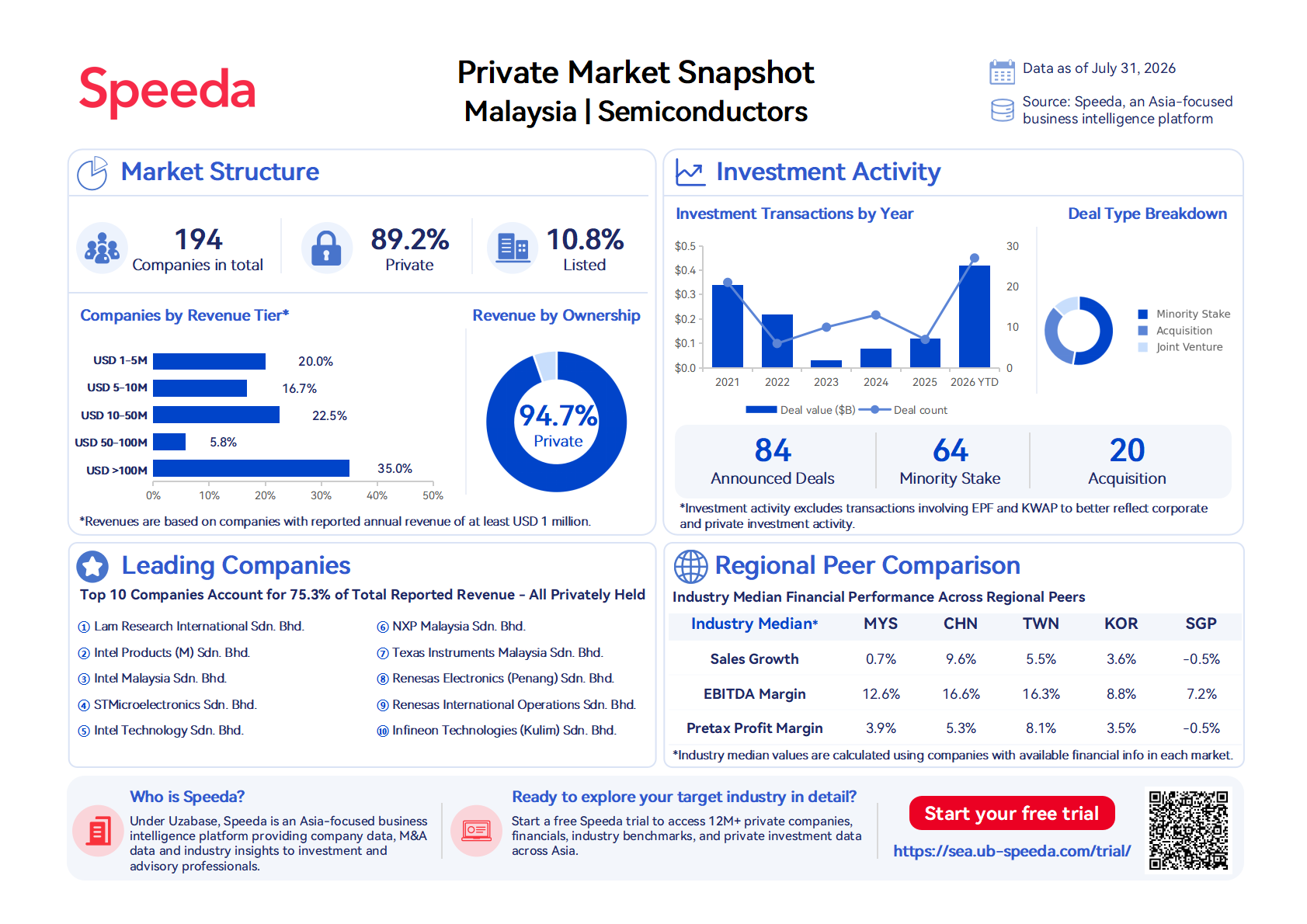
Malaysia’s semiconductor sector is a heavily foreign-anchored, privately held market that functions primarily as a crucial back-end assembly, testing, and packaging hub within the global semiconductor supply chain. Powered by Speeda’s private market intelligence, the sector comprises 194 identified companies, with 89.2% being privately held and private entities accounting for 94.7% of total reported industry revenue. Revenue is exceptionally concentrated: the top 10 companies account for 75.3% of total reported industry revenue.
While Malaysia remains an essential node for global chipmakers, its financial performance trails top regional design and foundry hubs like China on profitability. However, M&A and private deal activity have shown renewed momentum in 2026 YTD, dominated primarily by minority stake investments.
This Snapshot is generated based on Speeda, an Asia-focused business intelligence platform.
Key Takeaways
- Foreign MNC subsidiaries dictate market revenue: Private entities account for 94.7% of total reported industry revenue, with the top 10 players generating 75.3%. All top 10 companies (including Intel, Infineon, Texas Instruments, and STMicroelectronics) are privately held subsidiaries of global semiconductor leaders.
- Malaysia’s market structure is unlisted and highly concentrated: Out of 194 identified companies, 89.2% operate privately, anchoring Malaysia as a specialized back-end assembly, testing, and packaging (OSAT) hub rather than a fabless or design-led market.
- Profit margins lag regional front-end peers: Operating in lower-margin back-end services yields a median EBITDA margin of 12.6% and pretax profit margin of 3.9%. This trails design and foundry hubs like Taiwan (16.3% EBITDA) and Mainland China (16.6% EBITDA), though it remains ahead of South Korea and Singapore.
- M&A deal activity is driven by strategic minority investments: Between 2021 and 2026 YTD, 64 out of 84 announced deals (76.2%) were minority stake transactions, demonstrating corporate expansion and supply chain integration over full buyouts.
- Deal value rebounded sharply in 2026 YTD: Following a quiet 2023–2024 period, private investment value surged, driven by large-scale transactions.
- Data isolates corporate and private capital flows: Investment figures strictly exclude state pension allocations from EPF and KWAP, delivering a clear signal on private market M&A behavior and strategic corporate investments.
Methodology & Data Coverage
This Snapshot is powered by Speeda, an Asia-focused business intelligence platform combining private company data, industry insights, M&A deals and expert research.
Coverage
- 12M+ private companies worldwide
- 580+ proprietary industry classifications with company mapping
- 3M+ M&A and private investment deals worldwide
Methodology
- Revenue-based analysis includes companies with reported annual revenue of USD 1 million or above.
- Financial benchmark metrics are calculated using companies with available financial information.
- Investment activity covers deals announced during 1 Jan 2021 – 31 Jul 2026.
Insights Beyond the Snapshot
1. Why do private multinational subsidiaries dominate Malaysia’s semiconductor market?
Malaysia serves primarily as a global back-end assembly, packaging, and testing (OSAT) hub rather than a domestic design or foundry market. Because major global chipmakers establish local operating subsidiaries to handle OSAT and equipment manufacturing, the market’s revenue is heavily concentrated—the top 10 companies account for 75.3% of total industry revenue, and all 10 are privately held local entities of foreign MNCs like Intel, STMicroelectronics, and Texas Instruments.
2. How do Malaysia’s semiconductor profit margins compare to Asia regional peers?
Malaysia’s semiconductor sector operates with lower median EBITDA (12.6%) and pretax margins (3.9%) than Mainland China (16.6% EBITDA) and Taiwan (16.3% EBITDA). This margin variance reflects Malaysia’s concentration in labor- and capital-intensive back-end testing and assembly operations, whereas Taiwan and Mainland China capture higher-margin activities in front-end wafer fabrication, foundry services, and fabless chip design. However, Malaysia’s margins remain higher than regional peers like Singapore (-0.5% pretax margin) and South Korea (3.5% pretax margin)
3. How is private company data used for transfer pricing in Malaysia’s semiconductor sector?
Because 94.7% of industry revenue in Malaysia is generated by privately held entities—mostly operating as related-party subsidiaries—transfer pricing compliance requires screening non-listed private comparables. Tax and advisory teams use private market financial metrics (such as median regional EBITDA and operating margins) to benchmark intercompany pricing for assembly, packaging, and distribution functions against defensible independent arm’s-length peers.
4. What are the key M&A and private investment trends in Malaysia’s semiconductor ecosystem?
Investment activity is heavily skewed toward minority stake transactions rather than full buyouts, reflecting strategic corporate expansion and supply chain partnerships. Out of 84 announced deals between 2021 and 2026 YTD, 64 were minority investments while only 20 were full acquisitions. Excluding state-linked pension allocations (EPF/KWAP) reveals a sharp rebound in private and corporate investment value in 2026 YTD after a quiet 2023–2024 period.
5. How can dealmakers and research teams screen unlisted semiconductor targets in Malaysia?
Standard public registry codes (SIC/SSIC) often group semiconductor players broadly under general electronics or manufacturing, obscuring niche players. To build accurate target universes or peer comparables, investment professionals use specialized platforms like Speeda to screen private companies by granular activity — such as OSAT services, automated test equipment (ATE), or wafer substrate processing—cross-referenced with reported revenue thresholds.
- Recommended Content