

 spasia_lm@uzabase.com
Trend Reports
Singapore VC in 1H 2026: Bigger Rounds Set the Pace as AI and FinTech Lead Funding

Singapore’s venture vapital is becoming more selective, with capital concentrating in fewer, larger rounds across AI infrastructure, enterprise technology and regulated FinTech. This article is examines the funding signals shaping Singapore’s VC landscape in 1H 2026 and what they mean for PE/VC teams assessing companies, investors and regional opportunity. This is based on Alternatives.pe data (part of Uzabase).
To turn these insights into a concrete target list, request a demo and customized company list here.
A Stronger Funding Total, but a More Selective Market
Singapore’s venture market entered 1H 2026 with a clear pattern: funding increased despite fewer disclosed transactions, as investors concentrated capital in larger rounds across AI, data infrastructure and regulated financial platforms.
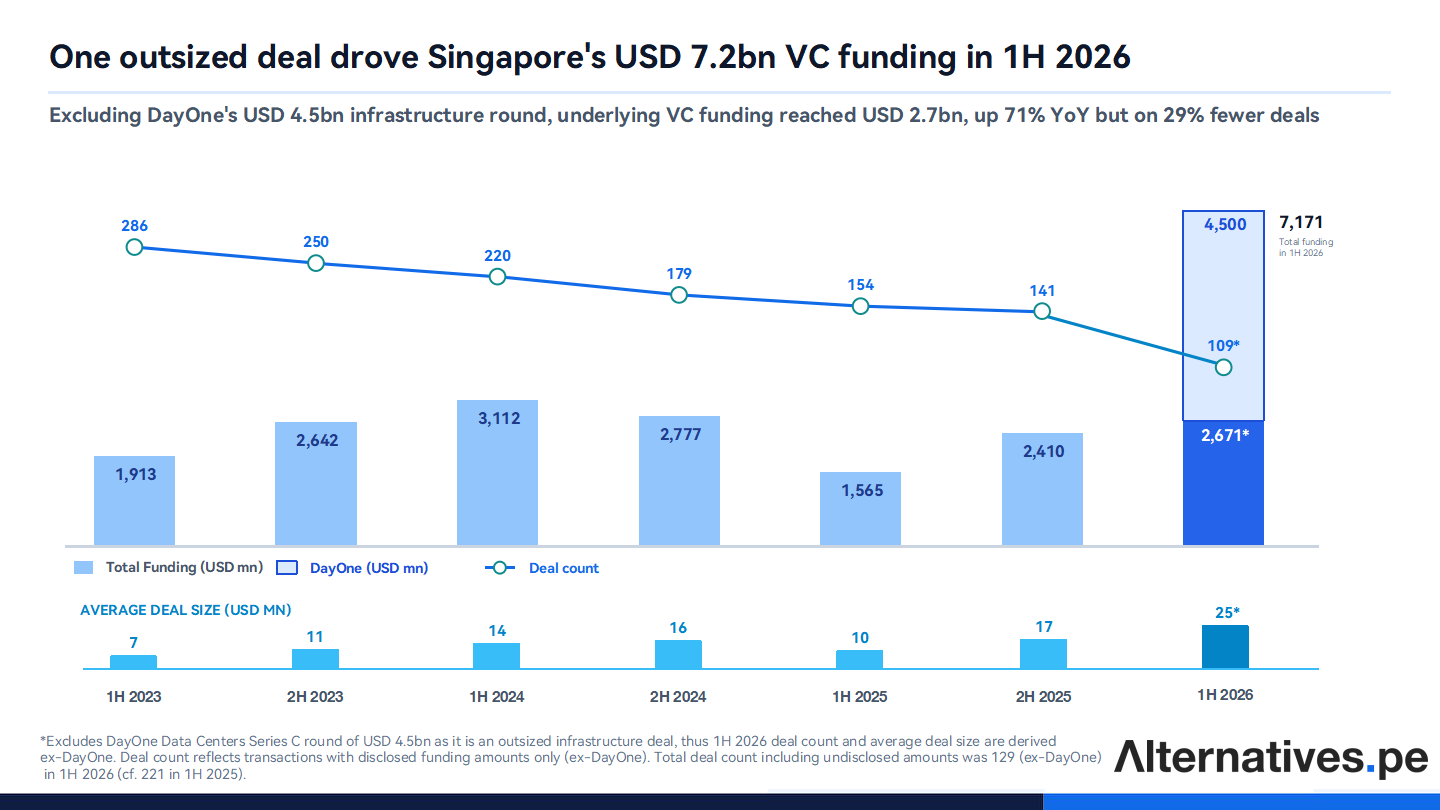
Singapore-linked companies raised USD 7.17bn in disclosed VC funding in 1H 2026. The headline includes DayOne Data Centers’ USD 4.50bn Series C round. Excluding that outlier, funding totalled USD 2.67bn across 109 disclosed-size deals—up 71% year on year, even as deal count fell 29%. Average deal size increased to USD 24.5mn, from USD 10.2mn in 1H 2025.
For PE/VC investors, the more useful question is not whether funding has returned to prior peaks. It is where larger cheques are going, what type of company can raise them, and how Singapore’s position as a regional holding and fundraising hub affects the interpretation of deal data.
Funding is led by a small group of larger rounds
Large transactions shaped the market in 1H 2026. Excluding DayOne, mega-rounds of at least USD 100mn represented 70.3% of disclosed funding. The top 10 active investors were involved in 46.2% of total adjusted capital, compared with 30.0% in 1H 2025.
This matters because the funding environment now rewards companies that can demonstrate a stronger institutional case: technical differentiation, meaningful market access, robust governance, and a credible path to continued financing.
The fundraising process itself is lengthening. Median time between rounds rose to 601 days in 1H 2026, from 409 days in 1H 2025. For investors, that creates a more useful window to assess operating performance between rounds. For founders, it raises the value of capital efficiency, reliable reporting and sufficient runway.
At growth stage, average disclosed deal size reached USD 100mn excluding DayOne, versus USD 49mn in 2H 2025. The result is a market in which a limited group of companies is attracting significant follow-on capital, while many earlier-stage businesses will need to meet more demanding commercial and governance thresholds before reaching the next financing milestone.
AI capital is moving into infrastructure and enterprise applications
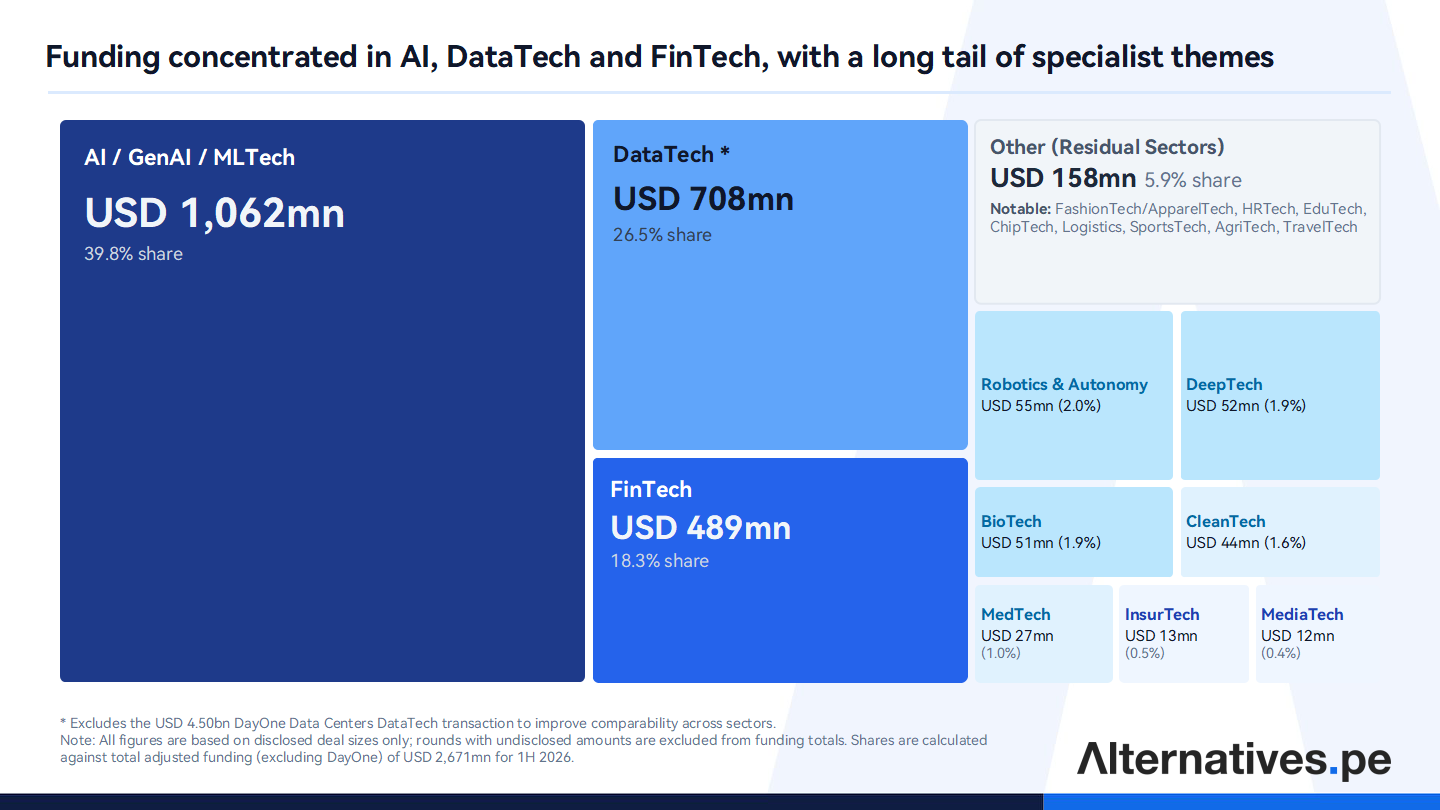
AI/GenAI/MLTech was the largest adjusted funding sector in 1H 2026, attracting USD 1.06bn across 28 deals, or 39.8% of disclosed funding excluding DayOne. Sector funding increased 316% year on year, even though deal count declined.
The trend is more nuanced than a general rush into AI. Singapore’s largest AI-related rounds centred on infrastructure, inference, enterprise use cases and specialised intelligence rather than frontier foundation-model development.
Firmus Technologies raised USD 512mn, while SiliconFlow raised USD 294mn in a Series B financing. These transactions point to investor interest in companies positioned within the infrastructure layer of AI adoption—where businesses can benefit from demand for compute, deployment tools, data systems and enterprise implementation
For PE/VC teams, the practical implication is to look beyond a company’s AI label. The investable questions are whether it has a defensible role in customer workflows, proprietary data or technology, enterprise distribution, recurring revenue potential, or strategic relevance to a broader infrastructure ecosystem.
FinTech capital is favouring regulated platforms
FinTech funding declined 12% year on year to USD 489mn across 23 deals, but the sector still accounted for 18.3% of adjusted funding in 1H 2026.
The moderation in funding does not necessarily signal a weaker investment case. Instead, it is consistent with a sector where capital is shifting from early-stage experimentation toward companies that have reached regulatory and operational scale.
Airwallex’s USD 320mn Series H financing, at an USD 11bn post-money valuation, illustrates the type of platform still able to attract growth capital. The company combines cross-border payments, multi-currency accounts, foreign exchange, treasury, spend management, billing and embedded-finance capabilities.
For investors, the areas to watch extend beyond payments volume alone. Regulatory permissions, local-payment-rail access, enterprise distribution, product breadth and customer retention can increasingly determine which FinTechs develop durable market positions across Southeast Asia.
Investor participation is becoming more selective
Singapore continues to attract new investor participation. 64.7% of deals in 1H 2026 included at least one investor making its first recorded appearance in the Alternatives.pe dataset since 1H 2023.
At the same time, syndicates became narrower. Average investors per deal fell from 3.8 in 1H 2025 to 3.6 in 1H 2026, while solo-investor deals increased to 39.5%, from 30.8%.
These metrics should not be read simply as a decline in investor appetite. They suggest a market where investors are more likely to form tighter syndicates around opportunities they know well, and where lead investors may take greater responsibility for diligence and conviction.
For PE/VC teams, this makes investor-pattern analysis more useful. Tracking repeat investors, follow-on participation, lead roles and stage preferences can reveal more about a company’s financing quality than a funding announcement in isolation.
Singapore deal data needs a regional company view
For PE/VC teams, the advantage is not simply seeing which Singapore-linked companies raised capital. It is understanding why capital is flowing to them, how their operating footprint extends across Southeast Asia, and whether their market position supports a credible investment thesis.
Alternatives.pe provides the deal-level signal; Speeda adds the private-company and industry context needed to assess the opportunity behind it. Together, they support a more complete workflow—from monitoring transactions and investors to screening targets, benchmarking peers and conducting early-stage commercial diligence.
- Recommended Content