

 spasia_lm@uzabase.com
Industry Reports
Speeda Private Market Snapshot | Thailand Processed and Packaged Food Products Industry Overview (2026)
Speeda Private Market Snapshot is a one-page industry overview designed to help investment and advisory professionals quickly understand market structure, leading companies, financial benchmarks, and investment activity.
Below is a sample Snapshot featuring Thailand’s Processed and Packaged Food Products industry. To explore your target industry across Asia, start a free Speeda trial or request a personalized walkthrough to access detailed data and insights here.
Market Outlook
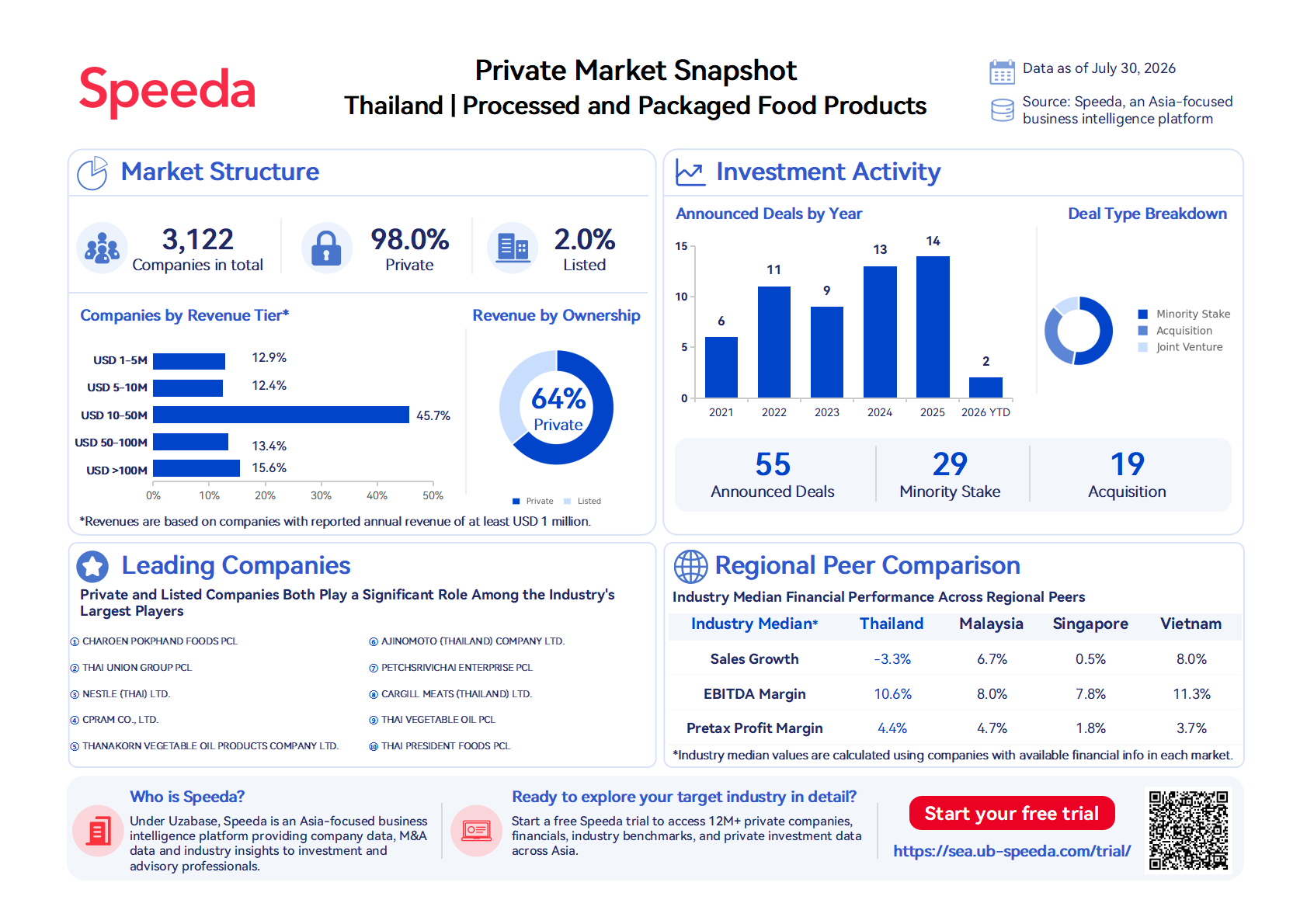
Thailand’s processed and packaged food products industry is a large, highly established sector encompassing 3,122 identified companies. Unlike markets where unlisted subsidiaries dominate almost entirely, Thailand’s food processing landscape features a robust dual structure where both listed conglomerates and private enterprises play significant roles among the industry’s largest players. While 98.0% of companies are privately held, generating 64.0% of total reported industry revenue.
On financial performance, Thailand’s processed food sector maintains strong operational efficiency, yielding a median EBITDA margin of 10.6% and pretax profit margin of 4.4%. This outperforms regional peers like Malaysia (8.0% EBITDA) and Singapore (7.8% EBITDA), sitting second only to Vietnam (11.3% EBITDA). M&A deal activity has remained consistently active.
This Snapshot is generated based on Speeda, an Asia-focused business intelligence platform.
Key Takeaways
- Both listed conglomerates and private entities drive top-tier market revenue: While 98.0% of the 3,122 identified companies are privately held, public listed companies command 36.0% of total reported industry revenue—led by giants like Charoen Pokphand Foods, Thai Union Group, and Thai President Foods.
- Industry revenue is anchored by middle-market firms: Almost half (45.7%) of all companies with reported revenue generating at least USD 1 million operate within the USD 10M – 50M revenue tier.
- Profit margins outperform most regional peers: Thailand’s median EBITDA margin of 10.6% and pretax profit margin of 4.4% sit higher than Malaysia (8.0% EBITDA) and Singapore (7.8% EBITDA), proving operational resilience despite a -3.3% dip in median sales growth.
- Mid-market deals dominate M&A activity: Out of 55 announced deals between 2021 and 2026 YTD, split between 29 minority investments and 19 acquisitions.
- Steady deal volume through 2025: Announced deal volume expanded steadily from 6 deals in 2021 to a peak of 14 deals in 2025
Methodology & Data Coverage
This Snapshot is powered by Speeda, an Asia-focused business intelligence platform combining private company data, industry insights, M&A deals and expert research.
Coverage
- 12M+ private companies worldwide
- 580+ proprietary industry classifications with company mapping
- 3M+ M&A and private investment deals worldwide
Methodology
- Revenue-based analysis includes companies with reported annual revenue of USD 1 million or above.
- Financial benchmark metrics are calculated using companies with available financial information.
- Investment activity covers deals announced during 1 Jan 2021 – 23 Jul 2026.
Insights Beyond the Snapshot
1. What makes Thailand’s food processing market attractive for M&A and PE investors?
Thailand’s food processing sector combines strong operational profitability with a deep supply chain of over 3,000 active companies. Investors are drawn to its dual market structure—allowing strategies that range from buying established mid-market private brand owners to partnering with large, export-driven listed conglomerates. The sector’s strong EBITDA margins also make it a reliable cash-flow generator relative to other regional markets.
2. How do advisors use regional margin data for benchmarking in Thailand?
Transfer pricing specialists use cross-border industry medians—such as Thailand’s 10.6% EBITDA and 4.4% pretax margins—to perform comparability analyses and establish arm’s-length price ranges for intercompany transactions. Because tax authorities scrutinize profit allocations between related entities in Southeast Asia, TP advisors rely on local private market benchmarks to justify profit split and net margin methods (TNMM) against defensible independent local peers.
3. What are the key challenges when sourcing deal targets in Thailand’s food sector?
The main hurdle in Thailand’s food industry is navigating its massive, fragmented middle market—where thousands of unlisted private producers operate. Many attractive targets in the USD 10M to USD 50M revenue band lack public disclosure. Deal teams must look beyond general registry filings to verify audited revenue, track minority vs. majority ownership stakes, and evaluate supply chain concentration before initiating outreach.
4. How can investment and research teams identify niche food tech or OEM players in Thailand?
Standard public industry codes (SIC/SSIC) usually lump food processing into broad categories like “Food Manufacturing,” making it hard to isolate specific niches like plant-based proteins, vegetable oils, or ready-to-eat packaging. Using specialized intelligence platforms with proprietary industry classifications allows analysts to screen companies by exact business activities and revenue thresholds rather than relying on high-level government codes.
5. What are the most common private market data challenges facing Southeast Asian dealmakers and advisors today?
Dealmakers and advisory teams in Southeast Asia consistently struggle with fragmented private company data, unstandardized financial disclosures, and inaccurate industry classifications. Because standard public registry codes lump distinct businesses into overly broad categories, investment teams often spend excessive hours manually building peer comps, verifying unlisted audited revenue, and cross-checking M&A deal structures across complex ASEAN jurisdictions.
- Recommended Content