


 spasia_lm@uzabase.com
Industry Reports
Speeda Private Market Snapshot | Malaysia Electronic Parts and Devices Industry Overview (2026)

Speeda Private Market Snapshot is a one-page industry overview designed to help investment and advisory professionals quickly understand market structure, leading companies, financial benchmarks, and investment activity.
Below is a sample Snapshot featuring Malaysia’s Electronic Parts and Devices industry. To explore your target industry across Asia, start a free Speeda trial or request a personalized walkthrough to access detailed data and insights here.
Market Outlook
Malaysia’s electronics industry is gaining renewed momentum as demand for semiconductors, data centers, AI infrastructure, and high-performance computing continues to reshape the country’s manufacturing landscape.
According to Speeda’s [Malaysia Country Report 2Q26+], Malaysia’s manufacturing sector grew by 7.3% YoY, driven by an uptick of electronic components and boards, communication equipment, and consumer electronics sub-sector (up 17.0% YoY).
The investment environment is also evolving. Malaysia’s International Development Finance Corporation discussions have highlighted digital infrastructure, semiconductors, data centers, critical minerals, and advanced manufacturing as strategic investment areas. Meanwhile, semiconductor-related developments such as SkyeChip’s 2026 IPO and MKS’s new manufacturing investment point to continued expansion across the electronics ecosystem.
But for investors and advisory professionals, the more important question is not simply how fast Malaysia’s electronics sector is growing. It is: who are the companies behind this growth, how large are they, and where is investment activity taking place?
To answer this question, we analyzed Malaysia’s Electronic Parts and Devices industry using Speeda’s industry, private company and investment data.
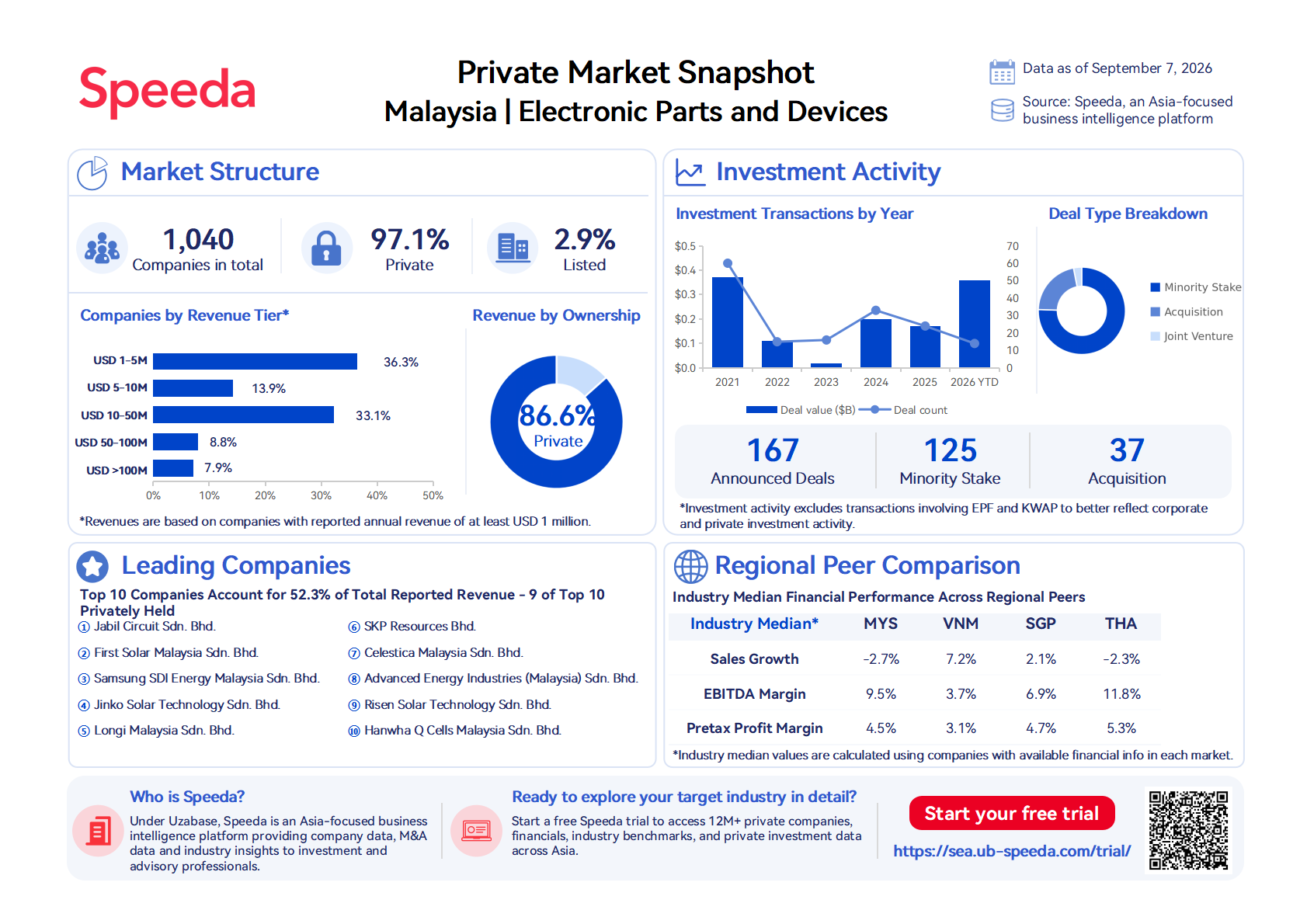
This Snapshot is generated based on Speeda, an Asia-focused business intelligence platform.
Key Takeaways
- The market is overwhelmingly private. With 97.1% of identified companies privately held, private company data is essential for understanding the actual company universe.
- Revenue is concentrated, but the company universe is broad. The top 10 companies account for 52.3% of reported revenue, while hundreds of smaller and mid-sized private companies make up the wider market. This creates opportunities to screen the market by company size rather than focusing only on well-known names.
- Investment activity is not limited to acquisitions. Of 167 announced deals, 125 were minority investments compared with 37 acquisitions. This suggests that the electronics opportunity in Malaysia is not necessarily being expressed only through traditional buyouts. Strategic investors also use minority investments to gain exposure to technology, manufacturing capabilities, supply chains, or specific growth segments.
- Regional benchmarking adds another layer of analysis. Speeda’s regional comparison shows a 9.5% median EBITDA margin and 4.5% median pretax profit margin for Malaysia’s Electronic Parts and Devices industry, compared with 3.7% and 3.1% respectively in Vietnam, 6.9% and 4.7% in Singapore, and 11.8% and 5.3% in Thailand. This allows analysts to ask a more useful question than simply “How large is the Malaysian market? This can be useful for market assessment, peer benchmarking, investment research, and comparable-company analysis.
For investment and advisory professionals, this combination of market structure, company financials, regional benchmarks, and investment activity provides a starting point for moving from a broad industry thesis to a more targeted company-level analysis.
The next question is not simply whether Malaysia’s electronics industry is growing. It is which companies are positioned to benefit — and which ones fit your investment, M&A or benchmarking criteria.
Methodology & Data Coverage
This Snapshot is powered by Speeda, an Asia-focused business intelligence platform combining private company data, industry insights, M&A deals and expert research.
Coverage
- 12M+ private companies worldwide
- 580+ proprietary industry classifications with company mapping
- 3M+ M&A and private investment deals worldwide
Methodology
- Revenue-based analysis includes companies with reported annual revenue of USD 1 million or above.
- Financial benchmark metrics are calculated using companies with available financial information.
- Investment activity covers deals announced during 1 Jan 2021 – 7 Sep 2026.
Insights Beyond the Snapshot
1. Why is Malaysia’s electronics industry attracting renewed investment interest?
Malaysia’s manufacturing sector grew 7.3% YoY in 2Q26, with electronic components, boards, communication equipment, and consumer electronics growing 17.0%. At the same time, data center and AI investment is increasing demand for semiconductors, electronics, and related infrastructure.
2. How can investors identify private electronics companies in Malaysia?
Speeda identifies 1,040 companies in Malaysia’s Electronic Parts and Devices industry, with 97.1% privately held and private companies accounting for 86.6% of reported industry revenue. Investors can screen this broader universe by sub-industry, revenue size, business description keywords and financial performance to identify potential targets beyond listed companies.
3. How can PE/VC and M&A teams build a qualified target list?
Start with your investment thesis, then narrow the company universe using sub-industry, revenue range, ownership and financial criteria. Speeda’s granular industry classification helps distinguish relevant electronics businesses within a broad market, while company-level financials can be used to prioritize targets for further diligence. This approach helps move from a broad industry list to an actionable target universe.
4. How can companies benchmark Malaysia’s electronics industry against regional peers?
Speeda enables analysts to compare industry-level financial performance across key Asian countries. More Besides the financial metrics showed in the snapshot, Speeda has more financial metrics available for assessing growth, profitability, productivity, efficiency, leverage, liquidity, valuation and shareholder return.
5. What does Malaysia’s electronics investment activity reveal about M&A opportunities?
Speeda records 167 announced deals, including 125 minority investments and 37 acquisitions. The prevalence of minority investments suggests that strategic investment and supply-chain partnerships are important alongside traditional M&A. For deal teams, combining transaction history with company financials and ownership data can help identify companies that may warrant further target or partnership analysis.
- Recommended Content