


 spasia_lm@uzabase.com
Industry Reports
Speeda Private Market Snapshot | Singapore AI Integrators Industry Overview (2026)

Speeda Private Market Snapshot is a one-page industry overview designed to help investment and advisory professionals quickly understand market structure, leading companies, financial benchmarks, and investment activity.
Below is a sample Snapshot featuring Singapore’s AI Integrators industry. To explore your target industry across Asia, start a free Speeda trial or request a personalized walkthrough to access detailed data and insights here.
Market Outlook
Singapore’s AI Integrators industry is one of 12 sub-industries within Software Services in Speeda’s Asia-focused proprietary industry classification system. It covers companies developing general-purpose AI-powered analytical software and those providing customer-specific AI integration solutions. The classification focuses on horizontal enterprise AI capabilities including analytics, business intelligence, data science and machine learning platforms, and AI implementation, while excluding AI businesses focused solely on a specific corporate function or industry, as well as companies providing a broad range of services beyond AI.
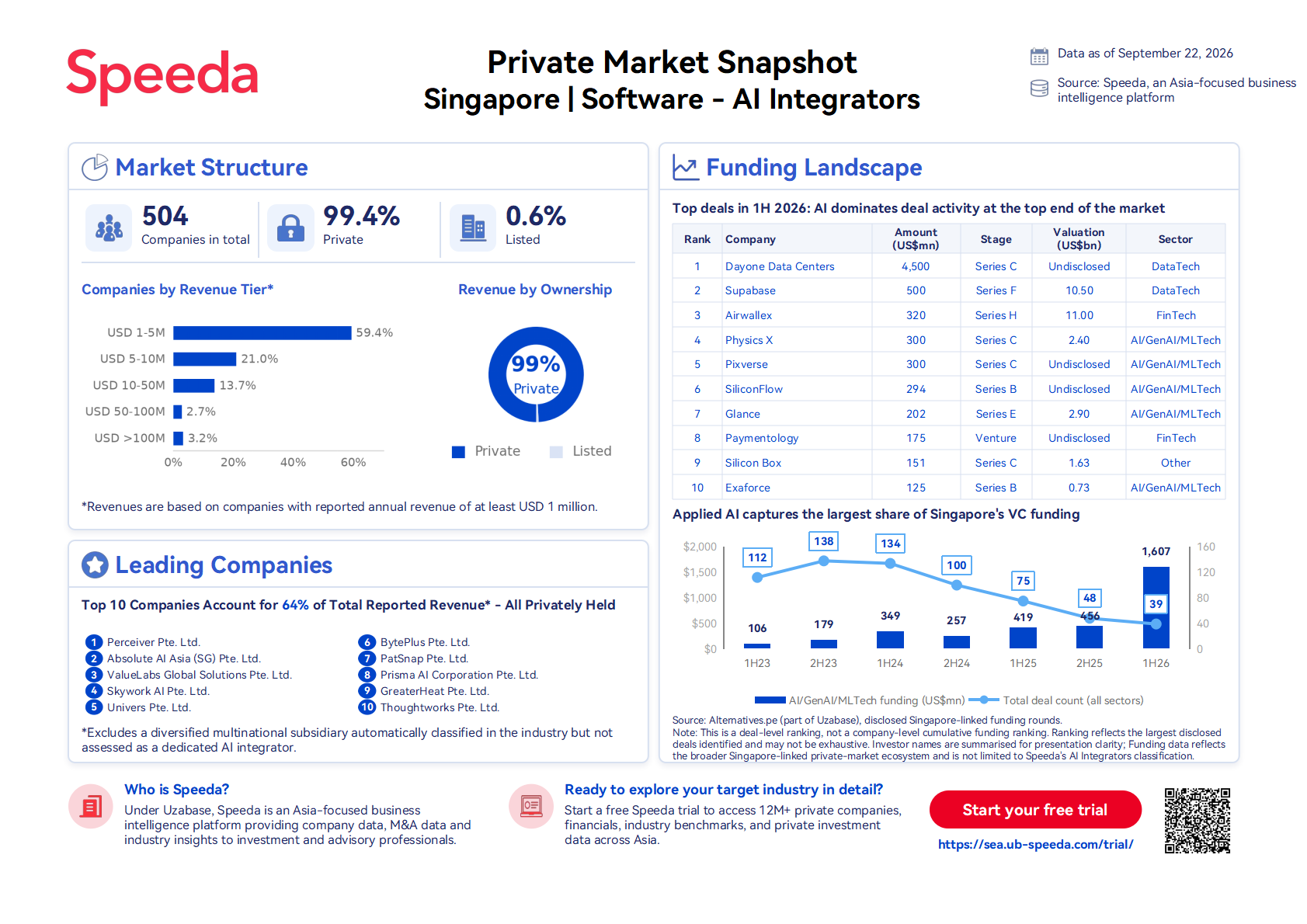
Singapore’s AI Integrators landscape is a highly private and fragmented market, comprising 504 identified companies, of which 99.4% are privately held. However, reported revenue is concentrated among a limited group of scaled operators: the top 10 companies account for 64% of total reported revenue, and all are privately held. This structure makes private company data essential for PE/VC investors seeking to identify scalable platforms, specialist implementation providers, and potential consolidation targets beyond the limited public market universe.
For investors, the opportunity is not simply to identify AI-labelled companies. It is to distinguish scalable, revenue-generating AI software and integration businesses from firms with limited proprietary capability, project-dependent delivery models, or unclear paths to repeatable enterprise deployment. Speeda supports this process with granular industry classification, private company financials, peer benchmarking metrics, ownership structures, funding history, and deal data across Asia.
This Snapshot is generated based on Speeda, an Asia-focused business intelligence platform.
Key Takeaways
- The market is overwhelmingly private: 99.4% of the 504 identified companies are privately held, and private companies account for 99% of reported industry revenue.
- Revenue is concentrated among a small group of scaled operators: The top 10 companies account for 64% of total reported revenue, and all are privately held.
- The market has a broad base of smaller companies: 59.4% of businesses with reported annual revenue generate USD 1–5 million, creating a wide universe of potential early-growth and consolidation targets.
- AI-related investment activity accelerated in 1H 2026: Singapore-linked AI/GenAI/MLTech funding reached USD 1.6 billion, the highest level in the period shown, despite total disclosed deal count across all sectors declining to 39.
- Large rounds drove funding at the top end: AI/GenAI/MLTech funding peaked in 1H 2026(+284% YoY) , with notable rounds from PhysicsX (USD 300mn) and Pixverse (USD 300mn).
Private company intelligence is central to target screening: Investors need to assess ownership, financial scale, funding history, and peer benchmarks to distinguish scalable AI software and integration businesses from the broader market.
Methodology & Data Coverage
This Snapshot is powered by Speeda, an Asia-focused business intelligence platform combining private company data, industry insights, M&A deals and expert research.
Coverage
- 12M+ private companies worldwide
- 580+ proprietary industry classifications with company mapping
- 3M+ M&A and private investment deals worldwide
Methodology
- Revenue-based analysis includes companies with reported annual revenue of USD 1 million or above.
- Financial benchmark metrics are calculated using companies with available financial information.
- Investment activity covers deals announced during 1 Jan 2021 – 22 Sep 2026.
Insights Beyond the Snapshot
1. What does “AI Integrators” cover in Speeda’s classification?
AI Integrators is one of 12 sub-industries within Software Services in Speeda’s Asia-focused proprietary industry classification system. It includes companies developing general-purpose AI-powered analytical software and those providing AI integration solutions for specific customers.
The classification covers horizontal enterprise AI capabilities, including analytics, business intelligence, and data science and machine learning platforms. It excludes companies focused only on a specific corporate function or industry, as well as businesses that offer broader services outside AI.
2. Why is Singapore’s AI Integrators market relevant for investors and advisory teams?
The market is overwhelmingly private: 99.4% of the 504 identified companies are privately held, while private companies account for 99% of reported industry revenue. This makes private company data essential for building a representative target universe.
Revenue is also concentrated among a limited group of scaled operators, with the top 10 companies accounting for 64% of reported revenue. At the same time, the market has a broad base of smaller businesses, creating opportunities to identify early-growth companies, potential add-on acquisitions, and consolidation targets.
3. What drives demand for AI Integrators?
Enterprise AI adoption is not limited to buying an AI tool. Businesses often need support to identify viable use cases, connect AI applications to existing data and systems, manage implementation, and scale successful deployments across workflows.
This creates demand for specialist providers that combine AI, data, cloud, and implementation expertise. For investors, the most attractive businesses are likely to demonstrate a repeatable delivery model, strong customer references, and an ability to move beyond one-off pilots into wider enterprise deployments.
4. What should investors assess when evaluating an AI Integrator?
Investors should assess whether the business can convert AI capability into repeatable, scalable enterprise revenue — not only whether it has an AI offering.
Key diligence areas include:
Recurring versus project-based revenue
Customer concentration and contract duration
Evidence that use cases can be replicated across customers
Proprietary software, data assets, or integration capabilities
Delivery-team dependence and gross-margin profile
Ability to expand into maintenance, optimization, managed services, or software subscriptions
AI integration engagements often begin as fixed-price projects. The ability to expand into recurring support or platform revenue can therefore be an important indicator of revenue durability and scalability.
5. How can Speeda support AI Integrators deal sourcing and benchmarking?
Speeda enables investors to screen and compare companies using granular industry classification, private company financials, peer benchmarking metrics, ownership structures, funding history, and deal data across Asia.
A typical workflow can begin with Singapore-based AI Integrators and narrow the universe by revenue scale, growth, profitability, ownership, funding status, and corporate relationships. This supports market mapping, comparable-company analysis, target prioritization, and identification of potential strategic buyers or add-on opportunities.
- Recommended Content