


 spasia_lm@uzabase.com

Trend Reports
State of Private Funds in Southeast Asia 2026: Capital is Committed but Not Deployed

This article highlights key findings from the “State of Private Funds: Southeast Asia” report, based on Alternatives.pe data (part of Uzabase). The report analyses 400+ active VC and PE funds focused on the ASEAN-6 countries.
Private funds in Southeast Asia are holding capital they are finding hard to put to work. Deal activity declined sharply in the first half of 2026, most funds remain early-stage or seed vehicles, and private equity is barely deploying. 125 active PE funds hold USD 52.2 billion in committed capital, yet only four PE-style deals were observed over the past 18 months. Returns tell a similar story: value on paper, but little cash back to LPs.
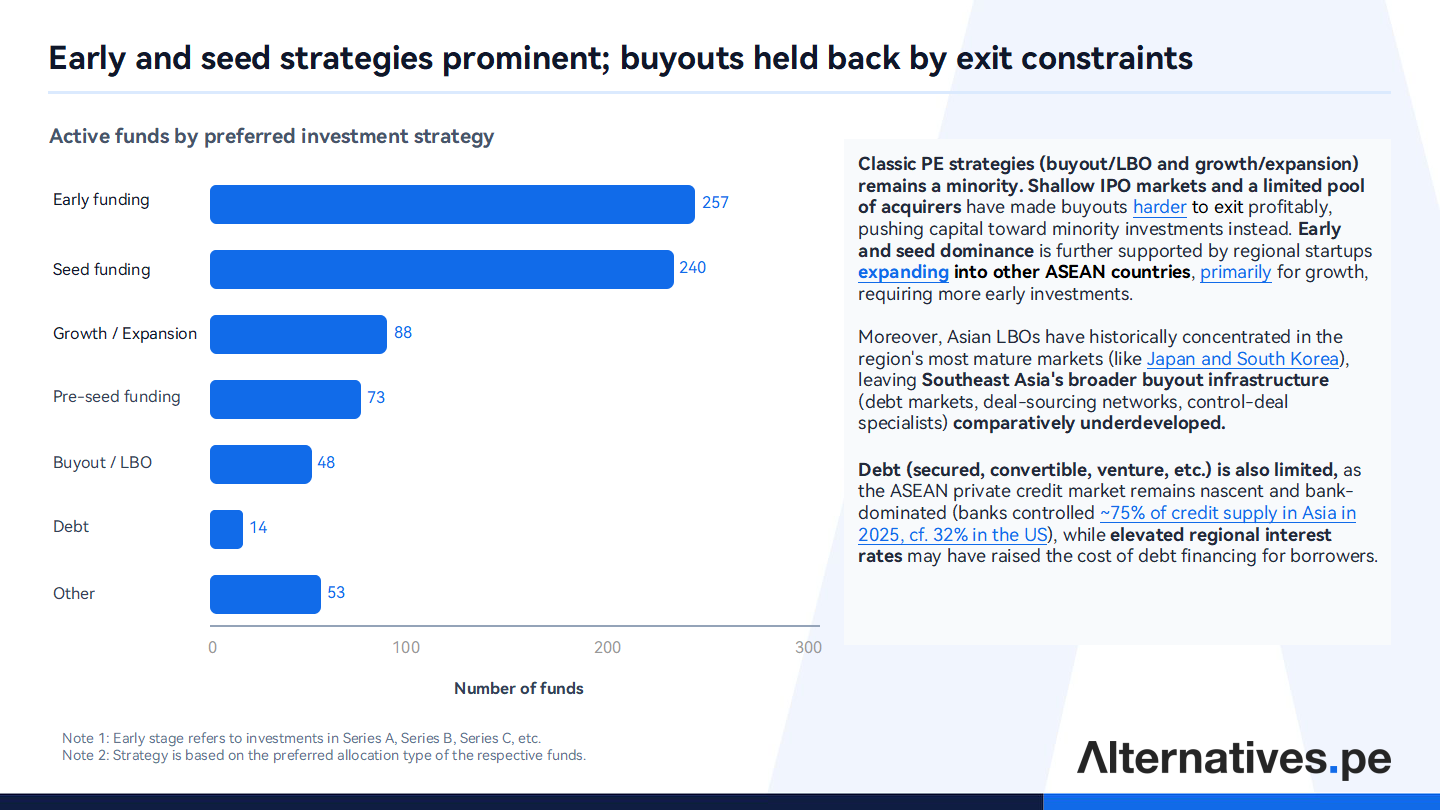
Early-stage strategies dominate and buyouts are held back
By preferred strategy, 257 active funds target early-stage rounds and 240 target seed funding, compared with 88 targeting growth or expansion and 48 targeting buyouts or LBOs.
The report links this to the region’s structure. Shallow IPO markets and a limited pool of acquirers make buyouts harder to exit profitably, which pushes capital toward minority investments. Southeast Asia’s buyout infrastructure, including debt markets, deal-sourcing networks and control-deal specialists, also remains less developed than in the region’s most mature markets.
The implication for investors: competition for deals concentrates at the early stage, while control opportunities are scarcer but less contested.
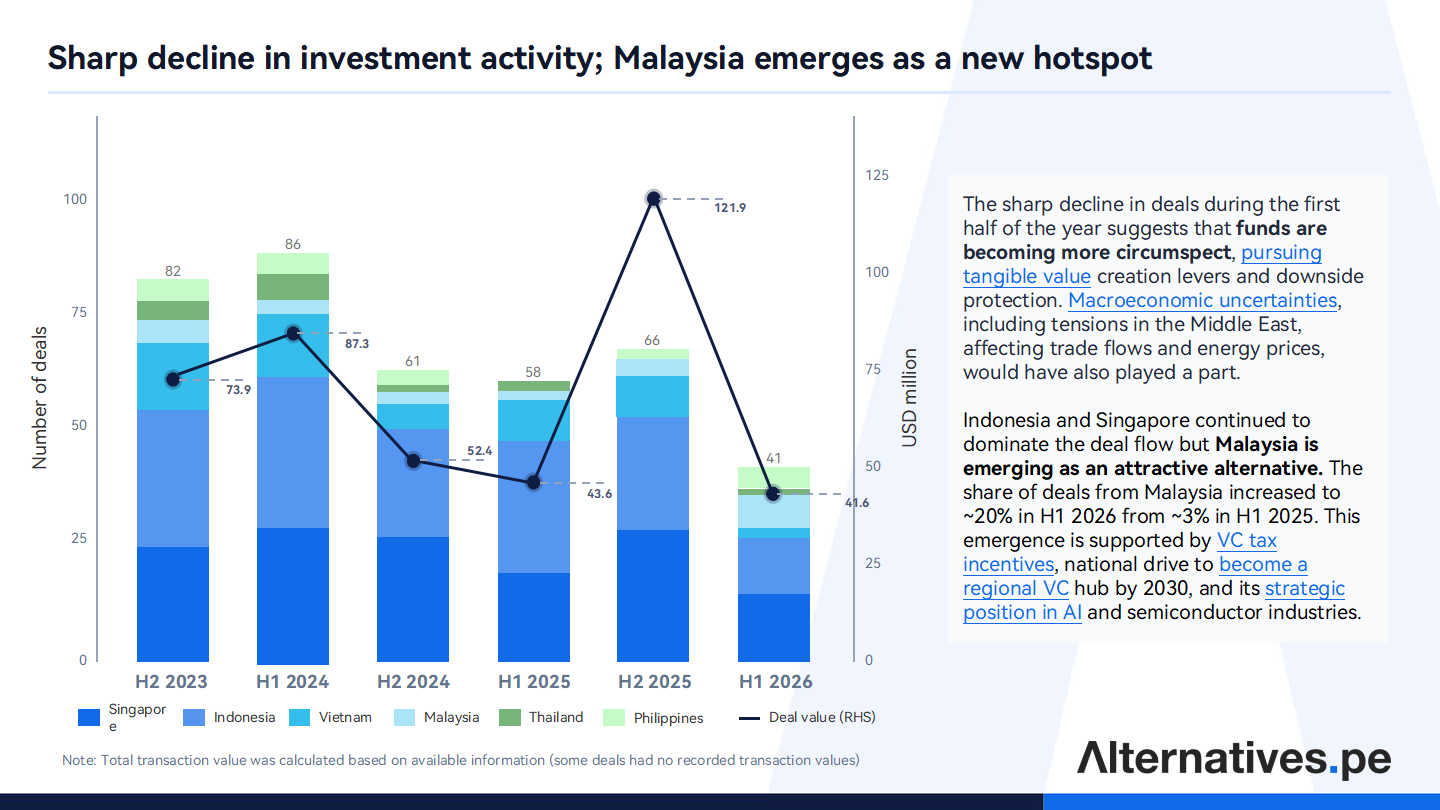
Deal activity slowed and Malaysia emerged as a new hotspot
The sharp decline in deals in H1 2026 suggests funds are becoming more circumspect, focusing on tangible value-creation levers and downside protection.
Indonesia and Singapore continue to dominate deal flow, but Malaysia’s share of deals rose to around 20% in H1 2026, from around 3% in H1 2025. The report points to VC tax incentives, a national drive to become a regional VC hub by 2030, and Malaysia’s strategic position in AI and semiconductors. Insurtech group PolicyStreet, for example, raised a Series C round in April 2026 to support regional growth.
By theme, FinTech remained the most popular, accounting for more than 20% of deals over the past 36 months. The report expects FinTech capital to shift from startups toward established players with proven profitability and regulatory moats.
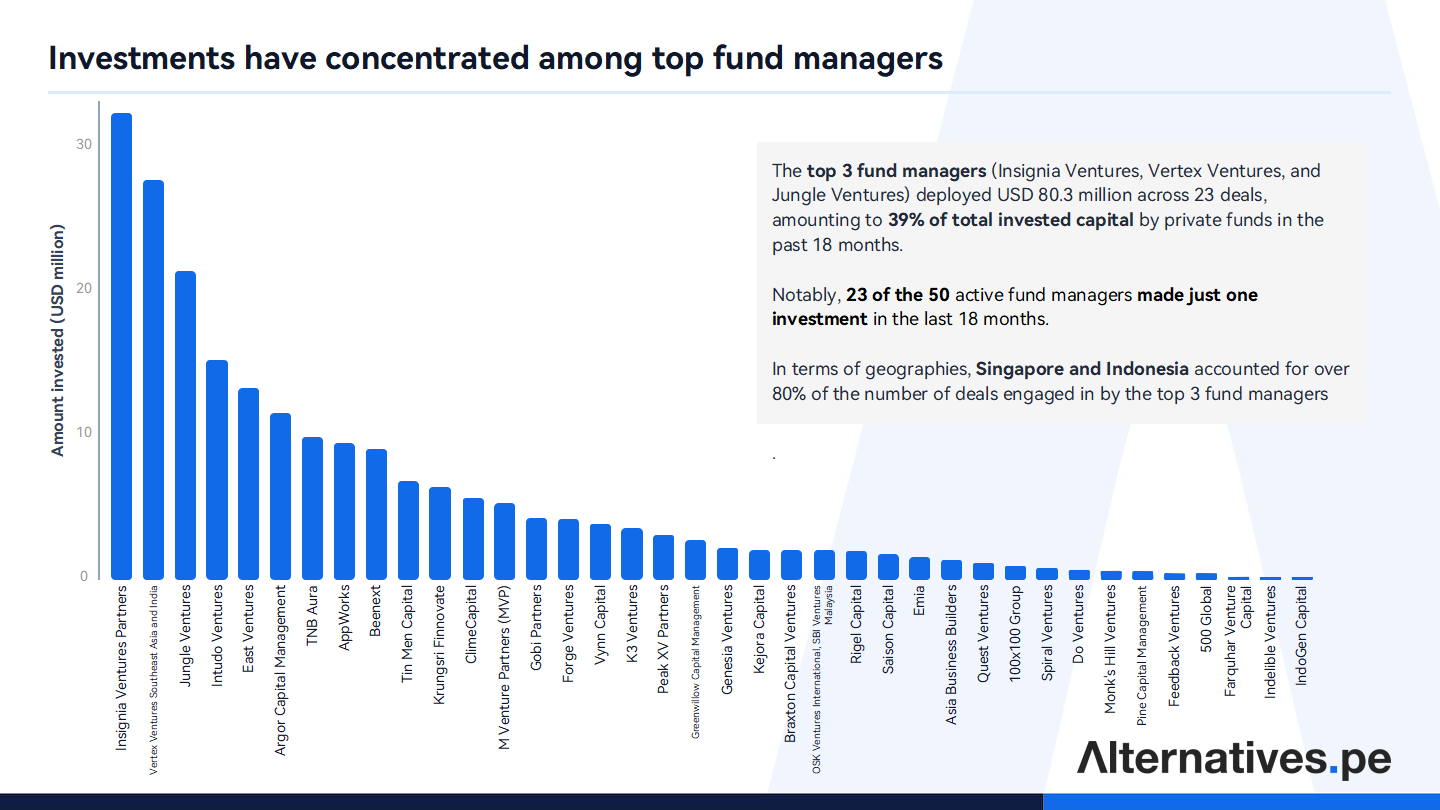
Capital is concentrated among a few managers
The top three fund managers, Insignia Ventures Partners, Vertex Ventures Southeast Asia and India, and Jungle Ventures, deployed USD 80.3 million across 23 deals, around 39% of total capital invested by private funds over the past 18 months. Singapore and Indonesia accounted for more than 80% of their deals. At the other end, 23 of the 50 active fund managers made just one investment in the same period.
The implication for investors: the pool of active lead investors is smaller than the number of funds suggests. Tracking who is actually deploying matters more than tracking who has raised.
PE capital is not moving
Of the 125 active PE funds, only seven transacted at all in the past 18 months, and only four executed a PE-style deal (M&A or a buyout in a growth-stage company).
This is not a fundraising problem: 91 of the 125 PE funds have already closed. The constraint is on the deal side. The region has few control-ready targets among its family- and conglomerate-owned businesses, and a shallow exit market makes a full buyout harder to underwrite than a minority stake in an early-stage company.
The PE-style deals observed include:
- Apis Growth Fund III (USD 1.2 billion) investing in BIPO, a Singapore payroll and HR platform
- Advantage Partners Asia Fund II investing in ITS Science & Medical, a Singapore medical and scientific equipment distributor
- Affirma Capital’s KINETIK Climate Transition I making its debut deal in Bright Nusantara Energy, an Indonesian renewable energy platform
Speeda’s M&A data points the same way. In the Speeda 3Q2026 SEA M&A Report, private equity’s share of startup deal value fell from 22.2% in 2Q2026 to 7.4% in 3Q2026.
Returns are on paper, not yet in cash
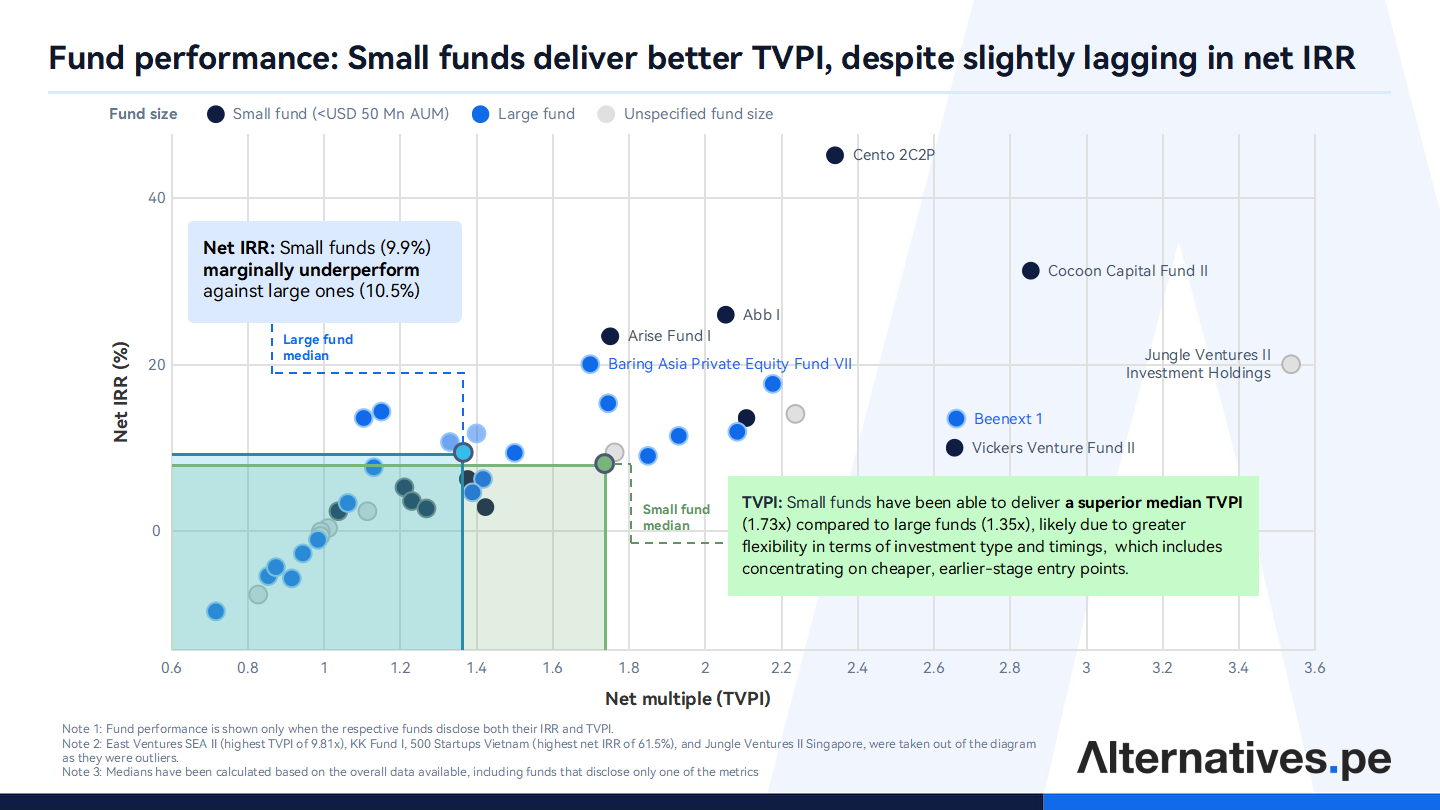
Funds with less than USD 50 million in AUM delivered a median TVPI of 1.73x, compared with 1.35x for larger funds, while net IRRs were broadly similar (9.9% vs 10.5%). The report attributes this to greater flexibility in investment type and timing, including cheaper, earlier-stage entry points.
Realisation remains limited. The median DPI was just 0.11x, against a median TVPI of 1.39x. Even vintages old enough to be distributing (2015–18) sit at a median DPI of 0.19x, and around 20% of them have distributed nothing, largely because IPO routes in the region are volatile and hard to access.
The implication for investors: exit planning increasingly depends on secondary buyers and strategic acquirers, and LPs are likely to scrutinise DPI as closely as TVPI in future fundraises.
From fund data to company research
For PE and VC teams, the key questions are which managers are actually deploying, where control-ready targets are emerging, and which exit routes are realistic.
Alternatives.pe provides the fund and deal-level signal: who is raising, who is deploying, and how funds are performing. Speeda adds the private-company and industry context needed to assess the opportunity behind it. Together, they support a complete workflow, from monitoring funds and investors to screening targets, benchmarking peers and early-stage commercial diligence.
For a closer look at fund-level data, including fund performance, active managers and their investments, start a free trial from below link.
- Recommended Content